
It is undeniable that Jane Schoenbrun is one of our most fascinating directors currently working. After their breakout film We’re All Going To The World’s Fair, Schoenbrun returned with 2024’s I Saw The TV Glow, one of the decade’s most stunning and original horror films (I was a bit cooler than my peers, admittedly, yet undeniably impressed). Now, Schoenbrun has returned to round out their unofficial trilogy surrounding media and identity with the incredibly-titled Teenage Sex and Death at Camp Miasma. Schoenbrun has clearly grown as a filmmaker and learned from Glow’s shortcomings, weaving a fascinating, funny look at gender, sex, identity, fear, the generational divide, and the horror genre. It does, however, feel like it does so at the cost of a more personal touch.
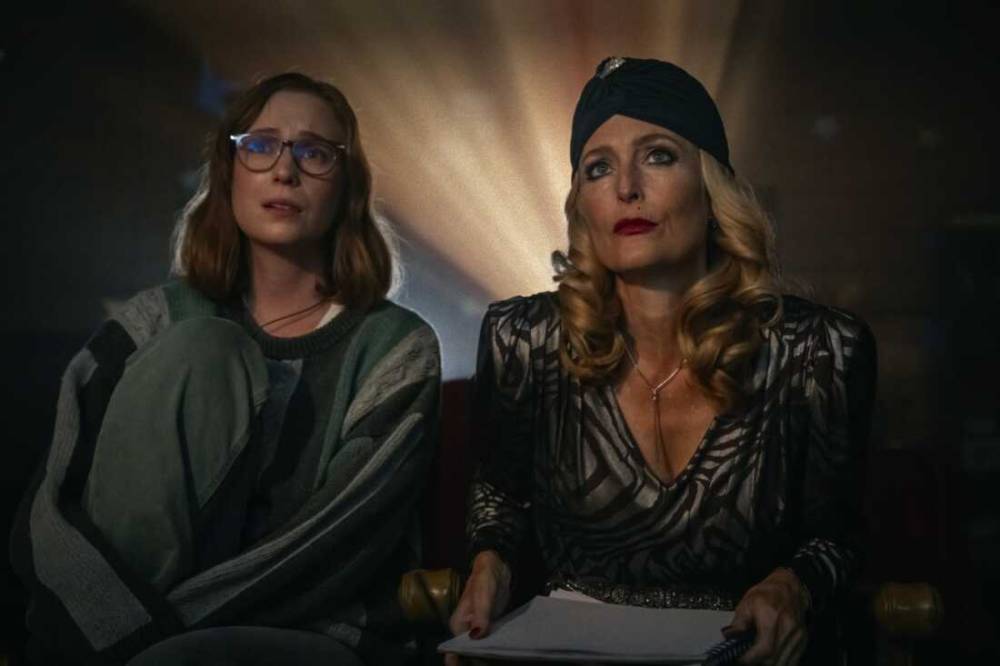
During the 80s, the Camp Miasma film franchise was one of the most popular slasher franchises around. Something of a cross between Friday the 13th and Sleepaway Camp, the film follows Little Death (Jack Haven), the ghost of a gender non-conforming teen who returns to take revenge on the campers that mocked and murdered them. After a dozen sequels of middling results, the studio hopes to revive the franchise for a new generation, hiring indie director Kris Williams (Hannah Einbinder) to craft a “woke” entry.
As part of her vision, Kris desires to cast original leading lady Billy Presley (Gillian Anderson, Amanda Fix in her Miasma days), now a recluse living at the old camp where the early movies were filmed. Billy is convinced that Little Death is real, and will return one day. But will they? And as Kris grows closer to Billy, what can Little Death teach her about her own complicated relationship with her gender and sexuality?
The sole flaw in I Saw The TV Glow was the messiness of its central metaphor. Schoenbrun perfectly captures the horror of being trapped in the wrong body, yet couldn’t fully establish their thoughts on media and nostalgia. This is not the case with Miasma, a film fresh with thoughts and imagery. In its hour-fifty runtime, Schoenbrun manages to explore horror’s complicated relationship with sex and blood (or, as Billy notes, “flesh and fluids” – all anyone really wants), as well as sexual hangups (especially surrounding generational differences and gender identity), movie studios preying on their viewers, and beyond.
Whereas Glow’s metaphorical television show was a bit vague in its connection, Miasma explores our relationship to media and what it says about us. This ranges from surface-level references to other slashers, or Billy’s modern-day Norma Desmond appearance, to the film’s more clever exploration of why “flesh and fluid” is such an enticing combination. While the film empathizes, and perhaps relates, with Kris’ sexual hangups (there’s a clear reading of Kris’ discomfort with her body and relationships), it also focuses on Gen-Z’s nature for choosing analysis over experience. Kris is so caught up making films about “Psycho from the perspective of the shower curtain” (a terrific joke) that she needs Billy and Miasma to help her let loose and remember the joys of sex – in essence, becoming the liberated star of a slasher franchise.
Ironically, however, for all of Miasma’s intelligence, it inadvertently stumbles into the opposite issue Glow faced. Whereas Glow’s central premise was so precise the rest of the worldbuilding occasionally felt pushed to the margins, Miasma has so much to say, it tends to lose track of Kris and the central allegory. Now, this feels like something of a nitpick, especially when you’re chewing on generational commentary or watching a box-headed slasher chasing an underwear-clad girl feeling free for the first time. Yet it’s a strange inversion to the say the least, and one that keeps Miasma as firmly “good” as opposed to “great.”
Not that Schoenbrun should feel too concerned – especially after seeing their craftsmanship evolve to such a degree. The confident director has a ball playing with tropes, techniques, and expectations. Editing constantly blurs the realm of “film” and “reality,” all captured with the crackle of 35mm film and parodying the traditional shots of the slasher genre (jump scares, POV shots, crazy zooms, etc.). And the production design truly shines, capturing an ethereal beauty in an otherwise nasty world.
There is a deeply felt sense of sensuality that permeates the screen – a sequence involving KFC dipping sauces is the most sexual dinner scene since Tom Jones in 1963. It’s a sensuality that lingers everywhere, from the central couple to the acts of violence. And the film really shines in its recreation of the genre, from hilariously bad lines (“So they killed him. They had to”) to brutal massacres. On that subject, the scene where Little Death becoming themselves set to “A Long November” is a strange sequence I find myself frequently thinking about.
Amongst the actors, Anderson has a ball with a heavy Southern drawl that sounds straight out of Tennessee Williams that accentuates her hysterical dialogue, yet emphasizes her character’s worldly, seductive quality (Fix is also an incredible Final Girl in the film’s “flashback” sequences). Yet this film wholly belongs to Einbinder. Einbinder has been giving one of television’s greatest performances for the last few years on Hacks, yet gets to shine here as a woman wanting to discover her own sexuality, yet struggling to bridge the gap between discomfort and desire. It’s one of the year’s finest performances.
There’s a great deal to admire with Teenage Sex and Death at Camp Miasma. If you’re looking for a send-up to the slasher genre, you’ll find it. If you’re looking for a sexy reflective on relationships, you’ll find it. If you’re looking for an incisive character study, you’ll find it (albeit slightly muddied). It is acutely entertaining proof that Schoenbrun continues to grow into one of Hollywood’s strongest directors. It’d be incorrect to call Miasma their masterpiece. In truth, it often plays as Mulholland Dr-lite. But couldn’t you do far worse than a decent version of one of cinema’s greatest films?
B+
Teenage Sex and Death at Camp Miasma is now playing in theaters nationwide


Add Comment