
Ultimately, there is no film more unnecessary than a biopic of Donald Trump. Beyond the fact that any film about a living President, even a controversial one, feels strange and incomplete due to the ever-evolving news cycle, there’s the question of who would even want to watch a film about the man. Democrats don’t want to watch a film humanizing him, Republicans don’t want to watch a film admitting he has any faults, and anyone who could parse the nuance (that he is a human being who has both committed and allegedly committed a litany of heinous acts) is just tired of hearing his name all the g*ddamn time. I myself made his name a verboten word on this site, as I think any direct reference to him is lazy and unnecessary in the realm of art.
This is the mindset I had entering The Apprentice, a film I only saw based on my appreciation for director Ali Abbasi’s last film Holy Spider. And overall, I’m not sure my mind has changed from my initial presumption. The film is filled with obvious allusions and “Cheeto Man Bad” slop that has oversimplified and demolished any semblance of critical thinking, appealing only to those who bemoan his “assault on democracy” while simultaneously kissing Dick Cheney’s bloody ring. Yet thanks to Abbasi’s mostly-careful eye, and tremendous performances by Sebastian Stan and especially Jeremy Strong, the film mostly works as an effective morality tale, exploring what how wealth and power change and corrupt us as human beings.
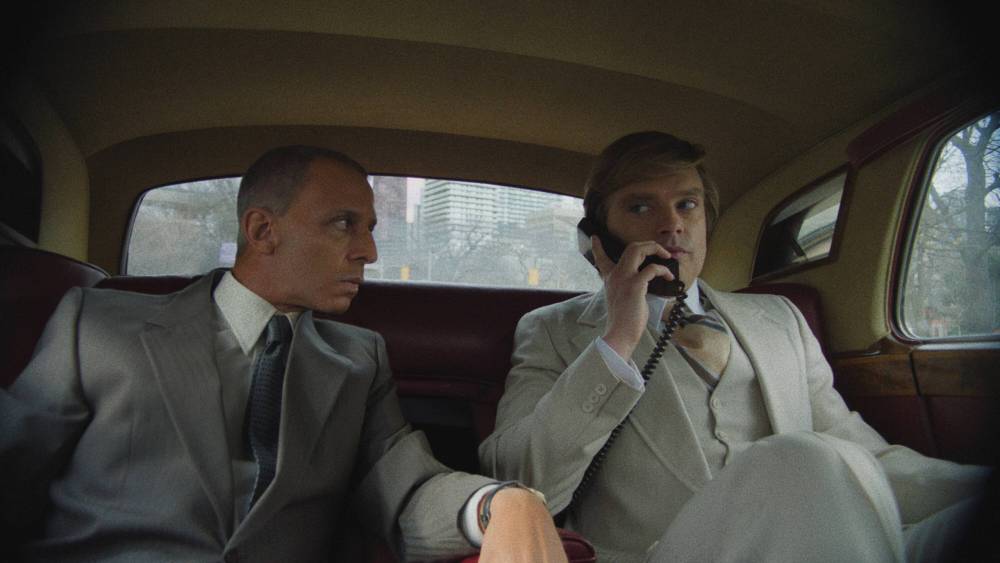
In 1973, Donald Trump (Stan) yearns to find acceptance amongst New York’s elites. While his family is certainly wealthy, they have yet to find acceptance within the city’s upper echelons, due to his father Fred’s (Martin Donovan) stubbornness involving growing the empire and a devastating lawsuit surrounding the company’s discriminatory housing practices. However, Donald soon gains a powerful ally in Roy Cohn (Strong), the infamous lawyer who served as McCarthy’s right hand man and had Ethel Rosenberg put to death. Cohn’s conniving ways have made him one of the most powerful figures in the country, and he decides to take young Donald under his wing.
Utilizing his three-point plan to control the narrative (Always attack. Never admit defeat. And claim victory as quickly as possible), Cohn encourages Donald to follow through on his ambitions with or without his father’s support. With Cohn’s guidance, Trump becomes a real estate mogul, negotiating and extorting deals to build impossibly lavish hotels, while charming the press to win over the public. But as Cohn’s stable position begins to crumble under the weight of years of corruption and a not-so-private secret, it soon becomes clear that the student will surpass the master.
What makes The Apprentice work – or at least keeps the film from the disaster it could have been – is the way it approaches Trump as a human being. While it is far from a glowing appraisal of the former president, Abbasi and screenwriter Gabriel Sherman (a fantastic journalist yet an incredibly mixed screenwriter) do what so few others have managed to do: find the humanity in Trump, both in his flaws and in his qualities. In an era where so many Americans view Trump as either a god on Earth or Satan incarnate, The Apprentice posits something deeper: that Donald Trump is a man, a man who has wants, needs, insecurities, a capacity to love and an innate desire to be loved, and the ability to be destroyed by his quest for fame and power.
At its best, the film shows a young man scrappy for acceptance – from society, from a cold and distant father, from a society that doubts his vision – who finds what he’s looking for in the arms of the literal devil. Through their relationship, he learns self-confidence and begins to see his dreams come true. By greasing palms and blackmailing city leaders, he manages to turn his father’s successful business into a billion-dollar industry synonymous with wealth. As Cohn teaches him to use his charisma to his advantage, he talks celebrities into buying shops and becoming friends as an act of self-fulfilling prophecy for his seemingly-impossible visions. He even gains the confidence to successfully court his dream girl, Ivana Zelníčková (Maria Bakalova). It’s the same journey as Charles Foster Kane, or Willie Stark, or Lonesome Rhodes.
For his part, Sebastian Stan is remarkable in his portrayal of a figure so many would lazily caricature. Gone is the Alec Baldwin lip-pursing or the bad attempt at the sinusy accent. Instead, Stan focuses on the nuances of the character. Each scene you can feel his desire to be loved and to connect with people, undeniably flawed but admittedly relatable. Stan’s eyes and face tell us everything we need to know about this man: his discomfort with some of the seedier elements of the person he’s becoming, but an obsession with the money and fame that comes with it. More importantly, he demonstrates the undeniable charisma (for better or worse) that still draws people into his orbit to his day. In fact, he only begins to utilize those iconic tics (the speech patterns, the hand gestures, etc.) once he’s begun his transformation, an apt metaphor if there ever was one.
Unfortunately, Sherman cannot resist gilding the lily and embracing in allusions and winks to both the modern day Trump and the more tabloid-y elements of his personality. Watching Trump defend his father’s overtly racist housing practices, or make backdoor deals through lies and manipulations to avoid paying taxes, are all fascinating in their own right – concretely true and directly associated with his downward spiral. What doesn’t work, however, are moments where Cohn introduces him to a young Rupert Murdoch and declares “I think you two will be important friends.” Or the frequent focus on his amphetamine usage and liposuction surgery. Or the controversial (and slightly exploitative) choice to show the alleged assault on Ivana in full. By the time Roger Stone is showing Trump a Reagan button that says “Let’s Make America Great Again,” you’re rolling your eyes and wishing for escape.
In fact, watching the film cop to its worst instincts on addressing the Trump of today, one almost wishes that this were a Roy Cohn biopic instead – and not just because of Jeremy Strong’s incredible performance as America’s most tragic villain. While famously covered in his final days by Tony Kushner in Angels In America, Cohn’s story – and his impact on American culture – is far more fascinating. A power-hungry lawyer who had people put to death and arrested for Communist sympathies, Cohn used his clout and power to get laws passed, control politicians, and persecute any “radicals” like Jewish people and homosexuals – despite being Jewish himself and dying of AIDS.
The film is at its best every time Strong graces the screen. Cohn is such a fascinating figure to watch, and the Succession star relishes in capturing him in his contradictions, his fervent ideology, and above all his human instincts. This is a man who intrinsically affected American politics – almost all for the worse – and utilized his “friends’” deepest, darkest secrets to dismantle democracy from the inside. It is a role one could play as irredeemably villainous, and Strong relishes in playing the villain, but he never loses sight of the human on display. He plays a man who had everything, lost it all (disbarment, alienation of his friends when his sexuality comes out), and, in the film’s most poignant scene, is publicly ridiculed at his final birthday by his former protége. The look on Strong’s face during this scene is as fine a performance as we’ve seen all year.
As for the filmmaking, it’s as about a mixed bag as its central take may be. As a filmmaker, Abbasi has always flourished when condemning dogmatically conservative regimes. After all, he famously has a contentious relationship with his home country of Iran due to Holy Spider’s condemnation of the religiously conservative government. Yet even in his condemnations, he finds the human inside the corruption – a sympathy for the devil, if you will. It’s what makes him uniquely attuned to tackling this story – critical of the soullessness while understanding that this is still a human being.
However, not every choice Abassi utilizes wholly works. For inexplicable reasons, the film is underlined with a punk aesthetic, utilizing sharp edits, grungy exteriors, and beyond to give the film an edge. However, the energy doesn’t quite fit the story on display. Nothing about these characters is notably rebellious or edgy. These are rich Wall Streeters interested in erecting buildings and making deals for clout. The slick edits don’t even match the energy of, say, Succession, which made the show feel lively and intense. Here, it feels more like an attempt at irony that never pans out. The most egregious is a far-too-soon and tone deaf edit that lazily occurs during Ivana’s assault, undermining the horror of the moment and making it feel like a tabloid scandal as opposed to a heinous act. I expected better of Abassi, and it emphasizes exactly that which keeps the film from being great.
The Apprentice is a mostly-successful, yet ultimately mixed, attempt to understand the most infamous figure in modern American politics. At its best, it feels like a modern Citizen Kane, or All the King’s Men, following an idealistic man as he conquered the world and lost his soul in the process (and a real, living figure with immense power, to boot). At its worst, it is a schlocky late-night sketch. However, despite any ill will I feel at the more egregious blanket statements, and the nagging feeling the film would’ve been better as a Cohn biopic, I can’t help but be impressed. This is a film that equally condemns and humanizes, plumbing the depths of our empathy and our shortcomings to explore what makes a demagogue. It’s unlikely to change any minds, but that’s ok. Those willing to actually grapple with a larger-than-life figure as a human being will appreciate the artistry and message within.
B
The Apprentice is now available to rent or buy on VOD


Add Comment