
I have had a complicated relationship with Wes Anderson as a director. Having seen all of his films, from his surprisingly normal breakthrough in Bottle Rocketto his stoic dollhouse concoctions in Moonrise Kingdom and Grand Budapest Hotel, I’ve come to realize that what keeps me at an arm’s distance – despite a clear understanding of comedy and filmmaking – is an apparent lack of humanity. His films are often hysterical and smart, yet they lack a semblance of human emotion (outside of The Royal Tenenbaums and Fantastic Mr. Fox, of course). Even when he tried to craft a film with “something to say” politically in Grand Budapest, the result was still an incredibly funny, yet emotionally distant production. I explain all this because, as we reach Anderson’s newest film, The French Dispatch, we reach perhaps the greatest irony of Anderson’s career: despite clearly attempting to give up on the human side of comedy and just embrace the silly, Anderson has ultimately managed to craft his most heartfelt, wide-eyed ode to art and humanity to date.
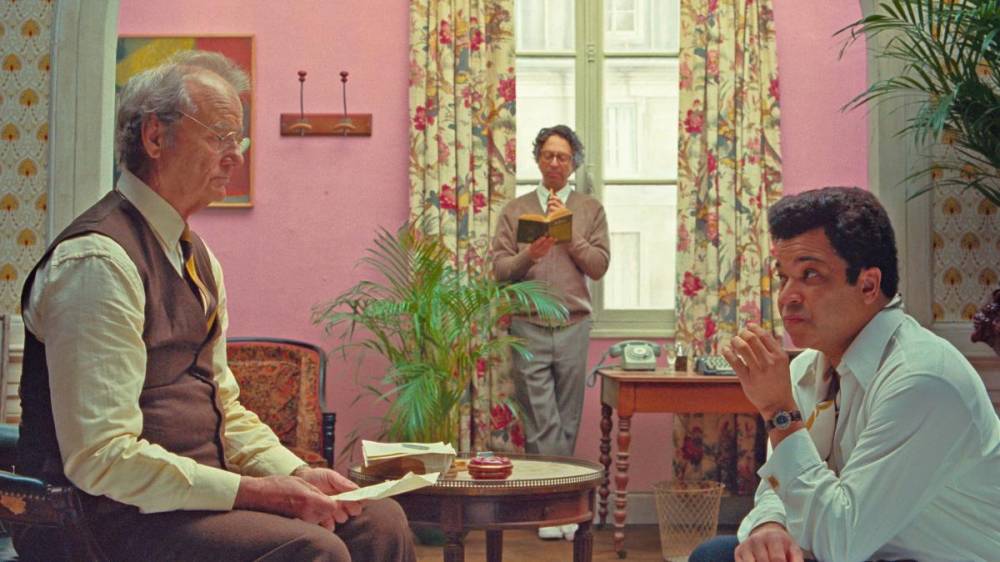
In 1975, Arthur Howitzer Jr. (Bill Murray) died suddenly of a heart attack. An expatriate living abroad in the town of Ennui, France (har har), Howitzer began a weekly column for his father’s small-town Kansas newspaper that eventually turned into one of the most popular publications in the world, thanks to an all-star writing team. Due to Howitzer’s final request to discontinue the paper in the wake of his death, one final farewell issue is constructed, based on three of their most popular articles – acted out in impassioned glory.
There’s “The Concrete Masterpiece,” J.K.L Berensen’s (Tilda Swinton) art piece about the infamously imprisoned painter Moses Rosenthaler (Benicio del Toro), who helped create the modern art movement based on his abstract nude portraits of his guard Simone (Léa Seydoux). There’s “Revisions to a Manifesto,” Lucinda Krementz’s (Frances McDormand) piece about her infiltration of a group of horny student revolutionaries led by pompous Zeffirelli (Timothée Chalamet) and his more radical rival Juliette (Lyna Khoudri). And there’s “The Private Dining Room of the Police Commissioner,” a widely celebrated piece by critic Roebuck Wright (Jeffrey Wright) about his time reviewing a famous police officer cook (Stephen Park) that devolves into a wild kidnapping scheme involving an international band of outlaws led by The Chauffeur (Edward Norton).
The French Dispatch is, without exaggeration, the funniest, smartest, and most heartfelt film Anderson has made since the children of Royal Tenenbaum tried to reconnect with their estranged father twenty years ago. This is a film about art and culture, and how they all relate to our innate humanity: relishing in it, advertising it, and celebrating it. After all, deep down, all humans have the same desires and dreams: we all yearn to eat good food, to have great sex with beautiful people, to see stunning, glamorous locales, and so on. Art is humanity’s way of exploring these passions, as well as questioning them. Why do we create, like del Toro’s Moses? Why do we fight, like Chalamet and Khoudri’s bickering revolutionaries? And why do we eat, and love doing so, like Roebuck? Dispatch seems to offer up a simple, yet definitive answer: it’s because it reminds us that we’re alive.
What’s perhaps most fascinating about the film is the way that Anderson’s otherwise-excessive flourishes actually emphasize this celebration of life and art, in a way his films really haven’t before. While Anderson and cinematographer Robert D. Yeoman have explored shifting aspect ratios and color schemes before, this is the first time it serves an actual narrative purpose: a black-and-white world gives way to bursts of color whenever art – or even a general sense of joie de vivre – are displayed for characters (and, to an extent, the viewer). This color is used to emphasize beauty in all its forms: a perfect artistic mural; a perfectly cooked meal; a beautiful girl’s eyes.
If it makes us feel good to be alive, it is emphasized by Anderson’s candy-confection color palette. There’s an excellent joke within the film where Adrian Brody’s art dealer scolds Moses’ reluctance with the saying: “All artists sell their work. It’s what makes them artists!” It’s a great gag, but it also sums up the film as a whole: that careful, complex balance between why an artist has to work vs. why they want to work: as a means of expressing themselves, and getting in touch with their emotions. All this from one throwaway joke. That is the brilliance of Anderson’s screenplay.
Of course, the film isn’t all esoteric reflections on the meaning of art and life. This is a comedy – and, as it so happens, Anderson’s funniest comedy to date. It’s a testament to his screenplay that he’s able to name the town Ennui, France and not have it be a twee dealbreaker. Perhaps he’s able to offset the cutesy nature with locales like “Pickpocket Cul-Du-Sac.” Anderson’s script ranges from the subtle (the fact that this is a Kansas newspaper’s dispatch is not lost on the viewer) to the vapid (upon being confronted with his flaws as a writer, one character proclaims “I only asked you to proofread it because I thought you’d be impressed with how good it already was!”) to the outright stupid. In that latter case, few lines in all of 2021 were as clever or as touching as “Her dark, stupid eyes watched me pee.” Anderson’s even able to explain away his usual overwritten dialogue – when all your characters and narrators are pretentious writers known for flowery prose, it’s easy to forgive over-the-top jokes.
And the jokes aren’t just verbally perfect – they’re visually perfect as well. I’m not sure there’s a working director in Hollywood as gifted as Wes Anderson when it comes to silly sight gags. Whether it’s too-tall buildings, a “Kansas Art Museum” located in the middle of a cornfield,” or a pinball machine labeled “Modern Physics,” Wes knows how to use his set for comedic effect. The editing by Andrew Weisblum uses a musical styling as a means of joke-telling. Actors portraying the same character appear in the same shot and trade costumes to demonstrate the passage of time.
Characters immediately follow up subtitles declaring a scene is three years later by declaring that “it’s three years later.” And just when you think the film can’t get any sillier, there’s an over-the-top animated sequence, just for the sheer hell of it. It’s all perfectly constructed, with the breezy feel of a French New Wave or New Hollywood sensibility, and yet it feels inherently modern in its sensibilities. I mean, how many other films can you name that feature roaming bands of choir boys out to wreak havoc?
As always, Anderson packs his cast with actors who understand his sensibilities and can execute it to a T. The difference here is that this time, he’s assembled an ensemble worthy of It’s A Mad, Mad, Mad, Mad World. There’s a campy, brilliant Tilda Swinton, Owen Wilson on an old-timey bicycle, and Bill Murray giving comforting, eternal advice; “Just try to make it sound like you wrote it that way on purpose” is the mantra he lives by. Three-time Academy Award winner Frances McDormand dominates the film’s middle half as a journalist who constantly declares she “must remain impartial” despite constantly interfering with her subjects.
And it’s hard to think of two better actors for Anderson’s affairs than Adrien Brody and Ed Norton. Brody might be the quintessential Andersonian actor – no other performer has successfully mastered going big within the confines of the stoic dialogue. Meanwhile, Norton relishes in the opportunity to be comedic, as he prances around in black-and-white thief clothes as though he’s a turn-of-the-century serial villain, or Black Bart in A Christmas Story.
However, it’s perhaps the newcomers to Anderson’s work that steal the film; like Léa Seydoux as a prison guard who, in less capable hands, could be a stuffy nothing (or worse, a sex object); or the ever-excellent Chalamet as an insecure, cocky revolutionary whose only two passions in life are f*cking and his nonexistent muscles. Benicio del Toro’s performance is moving and soulful, in a way only the Academy Award-winner can be. And in perhaps the greatest casting coup, Jeffrey Wright joins the troupe as a James Baldwin-esque food critic. Wright not only brings a haunting honesty and pain to the role, he also brings a mastery of turning a phrase. One minute he can deliver a moving monologue about the power of love in the face of bigotry, the next he’s delivering sly commentary like “I possess a love for typography – the curse of the homosexual.”
I’m still kind of in shock at The French Dispatch. I wholeheartedly believe that Anderson was just trying to have fun with this one, and yet it somehow emerges as one of his best films to date. His eccentricities amplify the story, and the story amplifies the emotion. I wouldn’t so much call it growth as a director – he clearly hasn’t learned anything he wasn’t already doing ten years ago. But it is an expansion, a send-up to a bygone era that reflects more on what we have in common than what we’ve lost to time and evolution. It’s a reminder of what makes us human, and all that goes along with it. And in a year that desperately requires good laughs and a reminder of our own humanity, The French Dispatchcouldn’t be more perfectly timed.
A
The French Dispatch is now streaming on HBO Max


Add Comment