
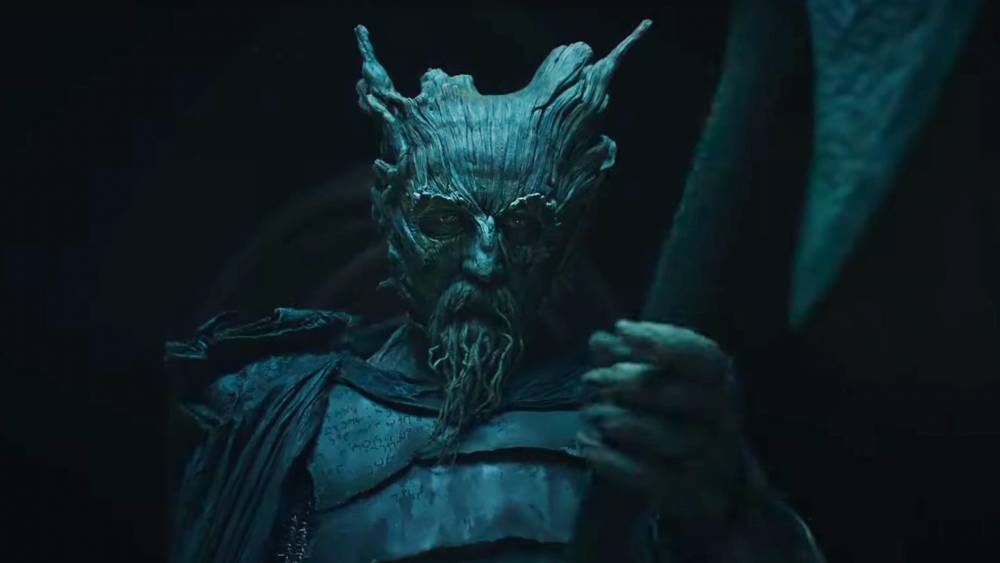
If there’s one thing that David Lowery is good at, it’s creating an immersive film experience. Whatever the general tone of his film may be – from the childlike innocence of Pete’s Dragon to the morose dread of A Ghost Story – Lowery creates a visual cornucopia that leaves viewers with the option to either embrace it wholeheartedly or get out of the f*cking way. In this regard, The Green Knight may be his masterpiece. While its thematic ideas surrounding existentialism and hero-worship may need a bit more fleshing out, the imagery that surrounds it is so overwhelming in its grandiosity, it is impossible to look away.
Gawain (Dev Patel) is the nephew of King Arthur of Camelot. Not yet a knight, Gawain spends most of his days drunk in the local brothel with his concubine Essel (Alicia Vikander). On Christmas Day, a mysterious, frightening creature called The Green Knight (Ralph Ineson) arrives in the Great Hall with a challenge: the bravest knight at the Round Table may strike him down, but with the caveat that in one year’s time, they must travel to the Green Knight’s chapel so he may return the blow. Looking to prove himself, Gawain leaps at the opportunity and lops off the challenger’s head…only for the Knight to pick it up and walk out the door. As Christmas rolls around yet again, Gawain must set out on a journey to hold up his end of the bargain – a journey that will test his bravery, his chivalry, and his own notions of heroism and mortality.
What you’ll notice about The Green Knight, right from the jump, is that this is a f*cking gorgeous film. Every aspect of the mise en scène is crafted in luscious, dazzling detail. There’s Andrew Droz Palermo’s cinematography, in which every shot is a painting – an essential component considering how long Lowery lets the shots linger. Everything is gorgeously rendered, whether it’s a tracking shot of Gawain on a horse or a skeleton trapped in a cage. These images are edited together by Lowery himself, amplifying his own surrealism with a series of simple, yet effective tricks; at one point, the camera begins to rotate to show the passage of time, not unlike an early image of a puppet show’s wheel. Is this to show that we are all just puppets in the universe’s grand joke? Who cares, it looks f*cking cool.
Meanwhile, enough praise cannot be heaped on makeup designer Barry Gower, who exclusively utilized prosthetics to design the Green Knight’s iconic look. The design of the Knight is perhaps the greatest character design witnessed in a decade; he is a massive, stump-like creature whose very aesthetic inspires interpretation. One minute he represents the toll of human suffering. Another he represents nature’s revenge on humanity. And still another represents the pagan rituals hidden under England’s burgeoning Christianity. And speaking of Christianity, Daniel Hart’s medieval hymn of a score interweaves with the imagery to elevate the experience. It’s a masterful score – one minute haunting, the next filled with whimsy. Hart’s work is the cherry on top of a masterful production design.
More important than the general look, however, is the way the film feels. Lowery has finally created the tone poem he’s always dreamed of; a dreamlike (well, nightmare-like is more accurate) act of poetic logic and imagery. Lowery incorporates his film with an air of magic and looming dread; it is a world easily summarized as “animals, snow, and grime.” Buildings burn in the distance, implying an ever-present sense of violence approached with an uneasy sense of calm. Witches led by Morgan le Fay watch over the action silently – perhaps even controlling the events playing out amongst the mere mortals. Foxes talk, ghosts mock, and giants walk around completely in the nude. Lowery talks all of this with a sense of austerity and unease…until he doesn’t.
Any time you expect him to zig, he zags, throwing in comically flowery and discomforting scenarios one right after another, whether it’s tongue-in-cheek rhymes, graphic realities of the world of the Middle Ages, or title cards that get more sarcastic as the film goes on – one describes the passage of time as “A Too Quick Year,” while another hilariously introduces “An Interlude” after an hour and a half of exclusively Interludes. It all builds up to a stunning, audacious conclusion that even those who know the story by heart will drop their jaws at. I’m not sure the last time I saw a film so viscerally unsettling in its depiction of history, metaphor, humor, and nightmare-logic. Most likely it would be Ken Russell’s The Devils.
These images and tones would certainly be enough to carry the film on its own, and yet they are elevated by the film’s underlying themes and ideas. First and foremost, The Green Knight is a story about the meaning of life – or, more specifically, its futility. When we meet Gawain, he is a wastrel, utilizing that he’s “not ready yet” to live life as an excuse to not try. He has an “idea” of what a great life is supposed to be – filled with bravery and chivalry, and supposedly unafraid of death. And yet, the entire purpose of his journey is not to find these traits within himself, but to realize that they won’t save him in the long run. This is a world where death is everywhere, and can strike at any time.
Even Arthur, so often portrayed as young and sexy and honorable, is past his prime – the one we see here is old, nearing the end of his life, and regretting his past decisions as he tries to reach out to family to make amends. Gawain’s journey is not to grow; his journey is to realize that the only constant in life is nature (hmm…green…) as humanity rises and falls and eventually will wither on the vine. Near the end of the film, Gawain laments, “Is this all there is?” and that is ultimately the film’s driving theme: that at the end of the day, all of the laws of man, of chivalry and honor, are meaningless, as we all end up in the same place.
And perhaps no aspect of life, in the grand scheme of things, is more futile than the art of hero worship. While Lowery does not blink at the notion of heroism or of decent human goodness, he does call into question the notion of putting human beings on pedestals. There is a desire to nostalgically reminisce about the art of chivalry; of men who seemed larger than life and accomplished great deeds through their supposed goodness. The Green Knight sets out to remind us that, at the end of the day, the knights of legend are, after all, simply flawed humans; humans who constantly fail and succumb to their own cowardice, and arrogance, and greed, and lust, and beyond. Lowery dares us to question why we view these characters as heroes. Is it because they vow to protect those less fortunate? How so?
Gawain is a sniveling coward who is unable to achieve a heroic deed worthy of a place at the Round Table. He does not receive praise or glory until he, ironically, succumbs to his own desires for violence, whether he’s beheading an unarmed man or making a power grab in the not-too-distant future. And what of Arthur, so often praised as a young and virile and noble King, here seen as a decaying old man most known for a violent war meant to “unify” the country, in which he killed 960 men single-handedly? The film forces us to confront our own collective psyches to find the truth: why do we erase the flaws which make our heroes human, and how can we reconcile these flaws with their own image?
These questions and flaws are brought to life by the actors’ performances, perhaps none more impressively than Patel. Patel carries this film, as he has so many times before, with a swagger and humor well beyond his years. It’s a challenging role – an actor who can fit the model of the classically chivalric knight while simultaneously succumbing to his own lusts and vices and fears. Patel makes each emotion believable, investing himself in the role so as to keep the narrative as flowing as the film’s themes and images. He is only outshone by Vikander, who plays at least two, or perhaps three roles popping up in Gawain’s journey. She plays each role with aplomb, usually espousing wisdom, realism, and nihilism in alternating fashion as she reflects on the state of the world, and Gawain’s role in it.
Barry Keoghan continues to be one of Hollywood’s best character actors as a swaggering, lecherous grave robber. Ralph Ineson possesses an inhuman air of mystery and terror as the Green Knight, and no other actor could play him. One of my favorite bit roles comes from Erin Kellyman as a ghost haunting a cabin in the woods. Arita Choudhury is properly haunting as the sage Morgan le Fay, while Sean Harris makes the most of his few scenes as King Arthur. In fact, the only actor who comes up short is Joel Edgerton, whose role feels about two scenes too short. He’s good, I just wish he’d had a juicier part.
The Green Knight is a surreal head trip that will leave you thinking about it months after you leave the theater. It’s a cold film that will wrap up your head more than it will your heart, yet will do so fully and capably. David Lowery has crafted his magnum opus; a full-fledged epic about lust and failures and humanity and death all wrapped up in some of the best technical detail you’ll ever see. It may be a few brush strokes of a masterpiece, but it’s almost better for that. It’s the type of big swing that doesn’t take place anymore (hell, I’m not sure I’ve ever seen anything like it), and while I may quibble about the strength of its themes and the logic of its story, I’m never going to fault a director for making something this accomplished, at any stage of his career.
A-
The Green Knight is now available on VOD


Add Comment