
If I’ve said it once, I’ve said it a thousand times: the best weapon a horror film can possess is a clear sense of dramatic irony. From Psycho to Halloween to It Follows, the best horror films work not because of cheap amusement park jump scares, but because the director manages to show us something that we know, but the characters don’t. It’s why Michael Myers is so terrifying – we’ve seen his set-up in advance, so when the character remains oblivious, the tension is so much worse for us. Director Leigh Whannell took that lesson to heart with his newest iteration of H.G. Welles’ The Invisible Man. And while the addition of real world gaslighting/abuse elements elevates the material to new heights, it isn’t even needed to make The Invisible Man one of the most terrifying, exciting horror experiences I’ve seen in a long time.
After several years in an abusive relationship with beloved engineer and businessman Adrian Griffin (Oliver Jackson-Cohen), Cecilia Kass (Elisabeth Moss) has finally made her escape. And when the news breaks that Griffin has committed suicide, and he left the entirety of his estate to her, it seems that Cecilia’s nightmare is finally over. However, she can’t shake that horrible feeling she’s had since she first started dating her ex – that there is someone watching her, waiting to strike. Someone who has access to her files and emails, and is systematically separating her from her sister Emily (Harriet Dyer) and her best friend James (Aldis Hodge). Someone who is causing a series of “accidents” around the house, like misplaced items and small cooking fires. Someone who seems to be ever present, even in an empty house, as if they were invisible…
I’ve often written about how the best horror movies have a message behind them. Halloween has a commentary on the evil beneath the surface of the suburbs, It Follows is about burgeoning sexuality in the Midwest, and Silence of the Lambs is about misogyny. The Invisible Man is not-so-subtly about abuse, gaslighting, and the way women cope with trauma – and yet this very lack of subtlety plays to the film’s strengths. Despite the twists and retellings of the Invisible Man tale since Hollywood first brought it to the big screen almost one hundred years ago, Griffin has never been a likable protagonist. While many a film has tried to justify or humanize his actions, Wells’ original novel always made it clear that its titular character was always a sociopath who released all his moral inhibitions the minute he was free of societal pressures. It’s a clear-cut case of man being the true monster, and Whannell clearly understands this. In rewriting the classic tale for the 21st century, Whannell understands that the person to sympathize with here is not the man driven to engage in criminality – it’s the victim, the woman driven insane by the man’s lustful, psychotic behavior. And that is what makes this film interesting. By following a character that we know isn’t crazy being slowly gaslit by a sociopath, it both tethers us to the protagonist and helps us recontextualize the material through a new, modern lens. It updates the material to reflect the types of stories we see all the time in the news – men who bully their girlfriends and wives into submission, play mind games to manipulate their victims, and oftentimes eventually murdering them (and with a splash of commentary on the manipulative abuse of power within the tech industry of its clients). Adrien is no longer the relatable, tragic figure that film often portray him as – instead, he’s a far more realistic douchebag scientist with a God Complex. And thankfully, we never have to pretend to relate to him, as the film keeps us squarely in Cecilia’s perspective and mind space. Her pain is our pain, her fight is our fight, and inevitably, as rushed as it may be, her karmic justice is our karmic justice. By bringing these themes to the forefront, the film manages to find the horror in real life and craft a horror film for the ages.
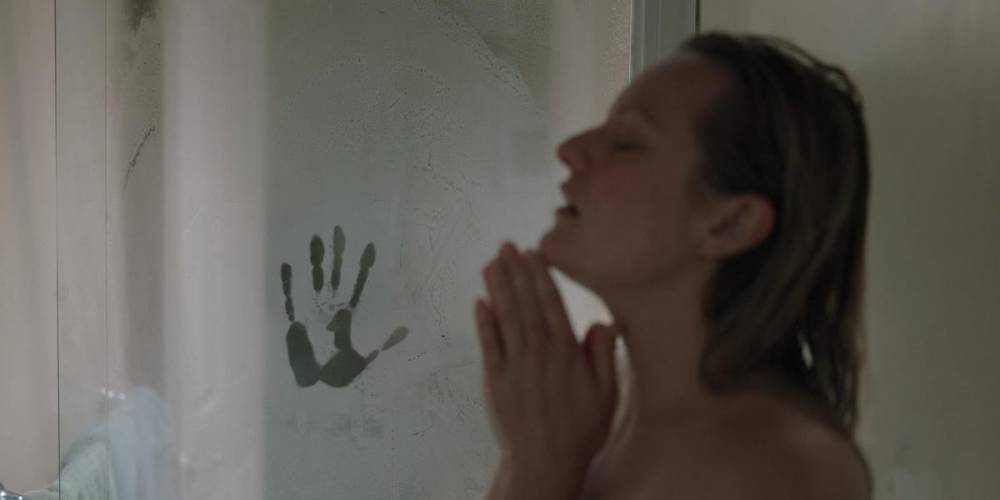
But the film isn’t just a representation of gaslighting – well, it is and it isn’t. Its thematic material is what elevates it as well as the glue that congeals it. For even if you were to cut the powerful moral at its center, you’d still be left with an impeccably made horror film that stands on its own. Whannell uses subtle, quiet effects do the heavy lifting, as opposed to the heavy effects work of most modern horror films. Where another film might double down on a jump scare or a giant CGI monster, The Invisible Man is fine toying with audiences emotions through small, mostly practical effects. A knife falls from a kitchen counter on its own accord. A stove begins to burn in an empty room. You can see a puff of exhaled air coming from an empty space directly behind Cecilia. You get the picture. Whannell refuses to resort to cheap jumps, instead building a scene slowly and smartly with hints and allusions that will have the audience screaming even as Cecilia is still putting two and two together. It’s the same type of filmmaking John Carpenter and Alfred Hitchcock perfected with their seminal horror classics, as characters emerge from empty black spaces or doors open soundlessly from behind a curtain. Even when The Invisible Man is forced to rely on a piece of bad CGI or a poorly staged effect (and there are one or two, don’t get me wrong), it adds to the film’s charm. The same way it’s still terrifying to see the breathing door in The Haunting, so too does the image of a floating knife make me cringe in all the right ways. And I can’t forget to mention Whannell’s use of sound, which he wields like a surgeon throughout. His use of sound in the film’s opening is enough to be taught in film schools, as careful cuts and swooping camera angles work in tandem with a silent set as Cecilia makes her dramatic escape from Adrien’s prison of a house. It’s one of the year’s most impressive sequences, and it is this level of expert craftsmanship that sets the tone for the film to come.
But Whannell’s greatest weapon of all, far and away, is his use of space in relation to the cinematography (framed by the great Stefan Duscio). While the film is squarely from Cecilia’s perspective, Whannell uses his camera’s angles to film wide open spaces, often with Cecilia alone in the frame. The massive sets and eerie calmness end up creating two different types of terror. The first has to do with the question of space. Knowing that there is a titular Invisible Man lurking about, the open sets and wide camera angles establish uninhabited space is our enemy. Adrien could be anywhere, at any time, and the fact that the frame is so wide will keep you questioning the emptiness in each and every frame. But the second, more sinister question of these shots is harder to grapple with: if Adrien can be anywhere, and we know he’s watching Cecilia…is the camera working as a voyeur, and turning us into the unknown Invisible Man? It’s a trick made popular in the 70s and 80s with films like Black Christmas and Friday the 13th, but unlike most of the slashers of old, Whannell’s voyeurism is never shlocky. He keeps our sympathies firmly with Cecilia, using Adrien’s abusive voyeurism as a tool only for terror – never exploitation. He’s using everything at his disposal – the sound, the editing, the direction, and the camera angles – to place us firmly in the head space of a victim of abuse, so that every viewer, whether they’ve been in that situation or not, can understand how terrifying the situation can be, mentally, physically, and emotionally. And sure, there are some moments that feel like missteps – the score, while never a true hindrance like, say, Gravity, is a bit overpowering, and some of the narrative choices don’t make a lick of sense (there’s a sequence at a crime scene where there’s no effort made to keep random passersby from casually walking right in). But at the end of the day, the strength of the filmmaking overrides any small quibbles.
As for the acting, the film is mostly a one-woman show. Elisabeth Moss is truly incredible here, giving one of her best performances yet as a woman driven to the brink of insanity by a sociopath. Yes, she’s terrific in the traditional scream queen sense, truly giving in to the terror of being hunted by a madman, but this is a performance that goes beyond just being terrified. Moss dives headfirst into the psyche of a woman broken down by years of abuse, and it can be seen in the little touches she gives the performance – the way she flinches whenever she enters the room, the way she guards her speech, and the way she caves in on herself whenever confronted. It’s a masterful performance, and will surely by a watershed moment in the genre the same way Daniel Kaluuya, Lupita Nyong’o, and Jodie Foster are currently considered. However, I also want to give credit to the rest of the cast, for outside of performances by Jackson-Cohen and Michael Dorman (who are both deliciously evil villains that will make your skin crawl in all the right ways), this is the rare horror cast (and honestly, rare cast period) to be comprised of solely likable people – a real treat. Hodge’s James is a truly trustworthy, reliable, and three-dimensional friend, whom it is easy to like, relate too, and bond with. His daughter, played by Storm Reid, is the rare child performer that doesn’t drag down a horror film, as she is equally charismatic and sympathetic (whereas most horror kids have you hoping the killer makes a pit-stop on his way to the horny teenagers). And Harriet Dyer gives a realistic performance as the sister of a truly unhinged character, one who tries to emote sympathy while continuously and understandably growing tired with her sibling’s constant fears, delusions, and mood swings. It’s a competent cast of artists designed deliberately to aid Moss in giving a truly unrivaled performance.
The Invisible Man is horror at its best. It’s what happens when you use a medium to tell a story with real, weighty themes and messages in a universal way – the same way Hitchcock, Carpenter, and Spielberg used to do. I wouldn’t go as far as to call Invisible Man a perfect film, by any means. In fact, there’s probably a perfect 90-minute cut out there, as opposed to its two-hour state. But who cares? It’s still entirely great as a two-hour cut, and it’s still frightening, entertaining, and exhilarating. It is the birth child of a slasher film and a classic ghost story, and it creates a new kind of terrifying experience the likes of which I haven’t seen before. It’s easily one of the year’s best films, and I cannot recommend it highly enough.
A-
The Invisible Man is now available to rent or own through most streaming services, as well as Blu-Ray and DVD


Add Comment