
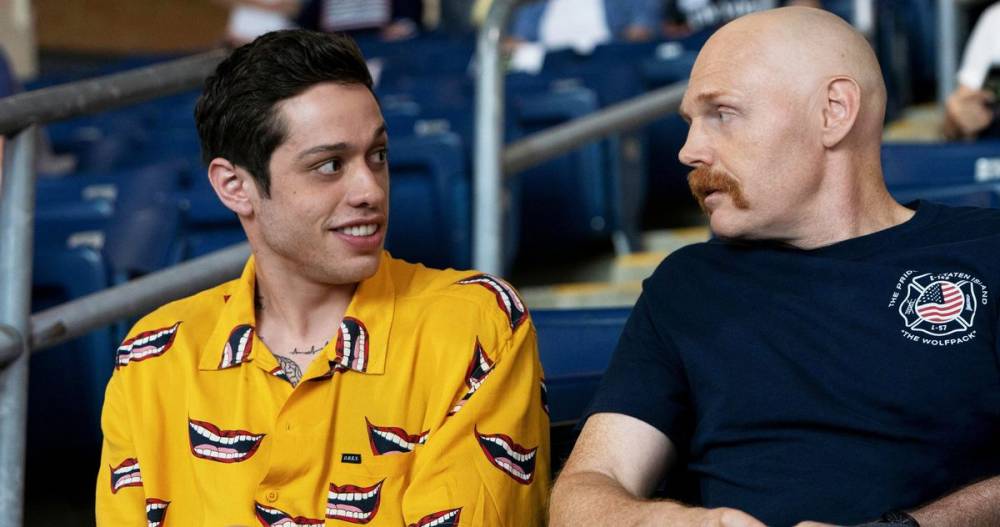
They say great art comes from great pain. And if there is any merit to that quotation, then Pete Davidson should be one of the greatest artists who ever lived. At the age of seven, his father died tragically saving lives as a firefighter during 9/11, leaving him with PTSD, an overwhelming sense of grief, and an overwhelmingly high bar to live up to. Added to already existing issues with Crohn’s disease and borderline personality disorder, it’s no wonder he turned to comedy as a means of dealing with the pain and pressure he’s been under. So it makes sense that one of his first major films, The King of Staten Island, should serve as a treatise on his grief and comi-tragic experiences. And the film, as it turns out, does end up proving two theories at the same time. First, that Pete Davidson is unequivocally a talented actor with rich range and impeccable timing. And second, that director Judd Apatow never has, and probably never will, understand how to properly structure, film, and edit a decent feature length comedy, no matter how many comedic geniuses he casts.
Scott Carlin (Davidson) is a f*ck up. There’s no other way to put it. Traumatized by the death of his firefighting father when he was seven, Scott is perfectly content having no ambition in life. At 24, he still lives with his caring nurse mother Margie (Marisa Tomei) and his overachieving younger sister Claire (Maude Apatow), who is preparing to leave for college. Scott’s days mostly consist of smoking pot with his friends, hooking up with his childhood bestie Kelsey (Bel Powley), and giving tattoos to random teens in the neighborhood – perhaps his only passion in life. However, things take a turn when Scott chooses to give a nine-year-old (Luke David Blumm) a tattoo, and the boy’s father Ray (Bill Burr) shows up. Ray is also a firefighter, and he happens to have a flame for Margie. With a new man in his mother’s life – and one who’s as foul-mouthed and temperamental as he is – Scott must confront his own demons, learn to take responsibility, and move his life forward.
I’ll start with the positives about Staten Island, because there are many things I liked about this film. Much of what drew me into the story – and by extension, Pete’s story – can be summarized by the opening sequence, in which we follow Scott on a drive down the highway. During this otherwise-normal sequence, Scott has a panic attack and closes his eyes at the wheel, swerving all over the place and nearly causing an accident before driving away panicked and yelling “Sorry,” mostly to himself. Not only is this a great feat of acting on Davidson’s part, but it drives to the heart of what makes this film work: the study of mental illness, particularly in the mind of this one young adult. At its core, Staten Island is the story of a young man struggling with the loss of a father whose legacy he can never live up to, and there’s nothing more to it than a fascinating character study. Davidson and Apatow use the former’s real life grief to find a sense of honesty and catharsis inside the character. One of my favorite moments involves Claire checking on her brother’s mental health when she notices he’s lashing out more than usual – an honest moment for those with mental illnesses and those who love them. A late-coming emotional scene where Scott hears stories about his father’s shortcomings and bad behaviors not only helps humanize their relationship, but truly helps the character bridge the gap between legacy and reality. And when Scott witnesses a fire and not only gains a newfound respect for the professions, but confronts his own PTSD (come on, you all saw it coming), it is some of the finest work Apatow has done in his career. When the film focuses on real scenes with real dialogue and real stakes, it truly works (more on this in a minute). There are some great character beats between Scott and Ray that have a lived-in structure (and culminates in subtle, touching moments that I really enjoyed). The romance between Ray and Margie is honest and cute. And the quieter character beats that Scott shares with other characters outside of his struggles add a lively joy to the film where it sorely needs it – scenes like Scott heckling a graduation speech, or finding sparks of joy in a little girl singing “O What A Beautiful Mornin.’” The King of Staten Island possesses a truly interesting, touching story about a f*cked up young man confronting his depression and grief and finally managing to move forward to his life, and it is in these scenes that the film works best.
Unfortunately for The King of Staten Island, that great story I just raved about is only one of like, ten different stories the film chooses to focus on. And the reason for this bad decision is Judd Apatow. The problem with Apatow’s filmmaking is that he too often gives himself over to vignettes. There are some directors that can handle the structural complexity of shaggy storytelling, where the story stumbles along to new scenarios before flushing out the themes that came before. In one scene, the focus of the film is Scott’s relationship with his family. In another, it’s a buddy film with Bill Burr’s Ray. Then it jumps to Scott learning responsibility from Ray’s two children, before becoming a crime thriller with Scott’s dopey friends. In fact, the only recurring through-line the film possesses is Scott’s dream to open a combination tattoo parlor/restaurant, which is just as dumb as it sounds, and ultimately, is kinda boring compared to the rest of the story. What’s more, because the film can’t make up its mind over its own story and which vignettes work best, the end result…just isn’t funny. In fact, it’s more infuriating because it forces every interesting moment to feel like an accident when compared to the moments Apatow deems “important.” There’s a terrific throwaway line where Burr compares Scott’s lot in life to famous sports heroes, demonstrating older generations’ inability to understand the differences in backgrounds and uprbringings. And the sequences of Scott being forced to interact with a group of elementary students is ingenious. But while a smarter film would lean into these concepts and tropes, Apatow pulls back, leaving them hanging on the tree like Forbidden Fruit. Instead, he focuses on clichéd archetypes and predictable conclusions (when Burr’s character notes that he’s “never gotten a tattoo” in his first scene, you know exactly how the film will end).
This style of filmmaking also results in a tonal whiplash, as the story never focuses on a thread long enough for the viewer to care. We’ll see glimpses of Scott’s mental health issues, but before that storyline is resolved we’re already jumping over to a man-child who’s obsessed with his mother dating again. And before we can settle in to this storyline, we’ve already moved back to his desire to be a tattoo artist. The film constantly jumps back and forth, switching between comedy, drama, dramedy, and cringe with little regard for the audience’s mood and reflection. And while a director of the caliber of Richard Linklater,Paul Thomas Anderson, or Todd Solondz may understand how to properly juggle these themes and interconnecting stories, Apatow never has and never will be able to properly structure a film capable of doing so. For example, observe Marisa Tomei’s character. For two acts (I guess? This film barely has a structure at all), Tomei’s character is established to behave a certain way, to act a certain way, and to respond a certain way. Then, out of the blue, her character drastically changes in the third act. Now, this wouldn’t be a massive flaw if it were borne out of character growth or personal decision making. But the only reason Apatow and crew change the character in such a way that Margie becomes completely inconsistent with her character that came before. It’s infuriating filmmaking, and strikes to the heart of Apatow’s laziness. Because instead of focusing on character growth, mental health struggles, and generational divides, Apatow chooses to just throw whatever interesting thought he has at the wall, shifting the narrative dramatically on a whim without any interest in the repercussions or ramifications of haphazardly mentioning them in the first place.
The other great failure of Apatow as a director is his insistence that unscripted improv is the superior art form. You see, Apatow films his movies “Curb-style,” encouraging his cast to go off-script to come up with the funniest lines of dialogue imaginable. Now, improvised material often makes for great comedy. Peter Sellers famously went off-script for much of Doctor Strangelove, and look how that turned out. But there are a few key differences between the usual improvisational material and what Apatow comes up with. The first is the test-screened nature of his films. As Apatow has about 20 different takes of every scene – sometimes with different endings and setups – he often shows several cuts to a wide selection of different audiences, creating something of a Film By Committee. Not only does this mean the jokes are dumbed down to the lowest common denominator (you’ll know it if it’s an unnecessary riff on masturbation, sex, or drugs that has nothing to do with the rest of the scene), but it also means the film itself will become disjointed, as there’s no semblance of story or screenplay to continue the themes. The other reason this storytelling structure fails is because, as opposed to a normal film where one comedian is offset by actual actors (think Elf), Apatow productions are mounted with a litany of comedians. This means, in order to earn the biggest laugh on set, the comedians are no longer thinking about traditional setups and deliveries, but instead trying to crack each other up – which is far different than making a traditional comedy or production. There’s a reason most comedians don’t tell “The Aristocrats” onstage – it doesn’t have the same impact in front of a crowd as it does among friends. Apatow films are a lowbrow version of “The Aristocrats” – only funny to the comedians filming the scenes, and leaving audiences disappointed, offended, confused, or all of the above. We are forced to watch great set-up after great set-up be ruined by obvious improvisations. And we are forced to watch 90 minutes of story get dragged out far beyond its limitations – the inevitable conclusion at the firehouse takes almost two hours to come to fruition, with almost nothing interesting coming before. Ultimately, it makes me believe that Apatow understands comedy, but he cannot create it. He clearly gets that Steve Carell, or Seth Rogen, or Lena Dunham, or Amy Schumer, or Kumail Nanjiani, or the millions of other stars he’s given breaks to are funny individuals, but unless he allows them to stick to a script and avoid the urge to improvise, he’ll never successfully make a funny, worthwhile property. In fact, I’d argue he should stick to producing – his resume in that department is far more impressive and deserving of his talents.
It’s a shame that Apatow’s filmmaking is so atrocious throughout most of the film, because it distracts from how great the cast is. Scene in and scene out, they manage to outshine bad material and bad editing, delivering honest, human portrayals – a rarity in a comedy such as this. In what may serve as a surprise to any fans of Saturday Night Live out there, Pete Davidson is a bona fide Actor, with a capital A. Not only is he capable of making jokes land through belligerent sarcasm and strategic doofiness (not unlike Chevy Chase), but Pete manages to prove in every scene that he possesses true emotional range. The scenes of his attempts to mask his depression and inner turmoil, matched with his inherent twitchy demeanor, hide an inner turmoil that may stem from a real place, but rarely reflect on the big screen with such raw honesty. Equally impressive is the performance of Bel Powley, the friend and love interest of Davidson’s Scott. Powley is impeccable as Kelsey, bringing the same level of trashy New Yorker that her costar Tomei once brought to My Cousin Vinny. In fact, Powley’s so good in the role that it is entirely possible the film suffers in its second act the way it does is because of her character’s disappearance for an hour. She needed more screen time. As for Tomei, she brings a real lived-in quality to the widowed mother of an insufferable man-child, and while her character is unfairly mistreated by the script, I loved her performance whenever she was onscreen. I’d also like to give a shout out to Maude Apatow, who defies accusations of nepotism by damn near stealing the movie. The eldest Apatow child has a long history of stealing bad projects with her unparalleled charisma (hi, Euphoria), and Staten Island is no exception, even if the film works better when she and her brother are getting along, as opposed to her usual state of antipathy. And as for the film’s secret weapon, I need to commend Bill Burr, who is a g*ddamn delight as Scott’s foil Ray. Burr is hilarious as Ray, especially as most of the film involves his attempts to avoid having a patented Burr blow-up. Burr is almost funnier trying to stay calm, and his sweeter moments actually help make the film. And while few performances outside this collection actually matter to the story, there are a few cameos and bit players appearing throughout that have a sense of impeccable time and true New York realness, including Moises Arias, Jimmy Tatro (who should really be in everything by this point), Kevin Corrigan, Pamela Adlon(!!!!!), and Steve Buscemi, who brings both a paternal pathos and true sense of heroism to the production, thanks to his storied legacy as a real life firefighter whenever he’s not giving Oscar-worthy portrayals.
The King of Staten Island is the type of film I hate to summarize, because how can I possibly judge it? Do I lean into the strength of this cast, and how moved I was by the scenes of Davidson confronting his traumatic past, both narratively and literally? Or do I give into my anger at the meandering plot, Apatow’s poor direction, and the film’s inability to keep me entertained for almost two hours and twenty minutes? Weirdly enough, the only people I’d recommend this film to are Davidson’s wide field of haters, both because it demonstrates his talents as an entertainer and because it’s two hours of actors straight up telling him how awful he is to his face. But otherwise? I think everyone would be okay missing this entry in Apatow’s growing field of man-baby semi-comedies. Maybe then he’ll take a hint and stick to producing.


Add Comment