
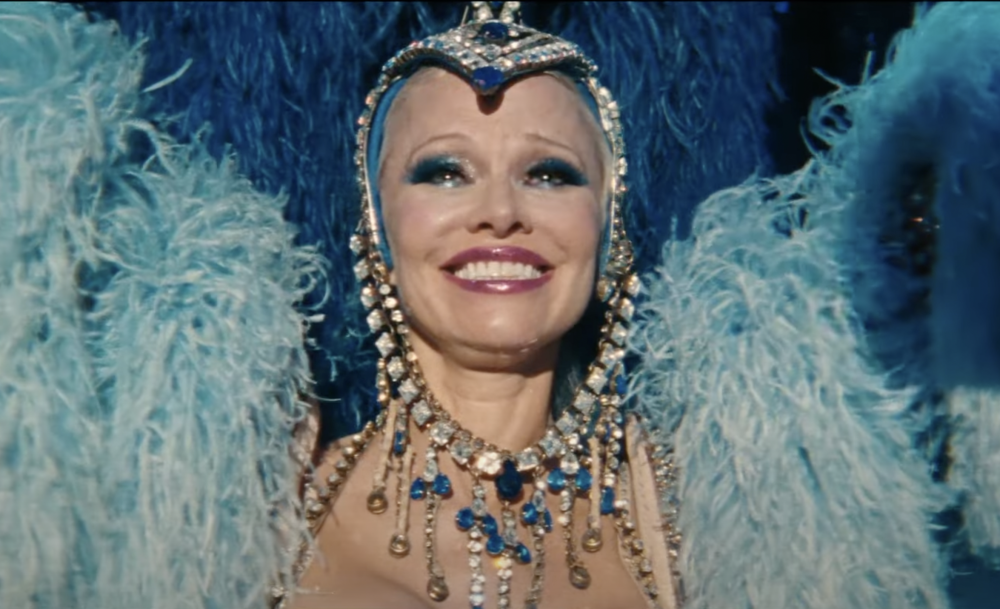
Watching a rising director finally come into their own is exciting. Watching an icon of the 90s cast off thanks to underwritten parts and sleazy tabloids finally come into her own is exciting. To watch both occur in the same wonderful film is simply magical. This is the experience of watching Gia Coppola’s The Last Showgirl. After a handful of mediocre indie films mostly lambasted by critics, Coppola finally has a chance to shine as a director with a gritty, intimate, human story about dreams and a shifting America, featuring a stellar ensemble, but especially its eponymous leading lady, Pamela Anderson.
30 years ago, Shelly (Anderson) joined Le Razzle Dazzle, a topless show in Las Vegas as one of its star attractions. For her shot onstage, she gave up on other opportunities and her own daughter (Billie Lourd) in her pursuit of her dream of dancing on stage. However, as the years rolled by, the more traditional act performed alongside her co-stars (including Brenda Song, Kiernan Shipka, and retired showgirl Jamie Lee Curtis) fell out of favor – too scandalous for the crowds that once considered it “classical,” and too tame for audiences looking for cheap thrills. With two weeks before closing, Shelly reflects on her life and career, and what possibilities await her outside Le Razzle Dazzle.
Coppola, through an impeccable screenplay by Kate Gerston, crafts her own unique story after the most universal of things: redefining yourself at the end of your career. This is a story about aging out of your one passion, of watching the very art you so passionately loved for decades die before your eyes, and coming to terms with the fact that you are no longer the young, independent force you once considered yourself. It’s a classic story – in many ways, this is just the strip-show version of Death of a Salesman.
Yet through this lens, Coppola and Gerston explore the additional layer of how to proceed in a patriarchal society when your greatest commodity – your beauty and your youth – are no longer viable. After all, the younger girls manage to find jobs at raunchier, more scandalous bars. But what awaits Shelly once Le Razzle Dazzle closes down? And what do you do when the lie you tell yourself – that you’re a real dancer, that your show isn’t every bit as risque, etc. – comes crumbling down?
Gerston uses Shelly’s character as a medium for these ideas to great effect. We watch as she struggles to maintain the lie that her dancing is important, that it’s “an ode to days gone by.” Any crushing of this illusion (or delusion), be it by costar, her own daughter, or directors she auditions for, is enough to send her on a spiral. Yet we can’t help but root for her. The film’s most haunting moment comes when intercutting her breakdown with a drunk Curtis dancing on a table living out her glory days to “Total Eclipse of the Heart.”
As a director, Coppola lets her camera work as a silent observer, simply capturing the women’s interactions and emotions without any ostentatiousness. We witness the women in their more human moments, simply talking and joking and fighting, only finding their way onstage in the film’s triumphant final moments. Because ultimately, that aspect doesn’t matter. The dancing and the nudity are a part of life, as mundane and uninteresting as any desk job, and are treated as such. It’s a very 70s approach, letting a lively and unvarnished camera and kinetic editing service the performer, not the director.
As the film’s titular character, Anderson is truly remarkable. Obviously, much of the casting involves playing on her press image – a model cast on a cheesy television show and who always wanted to prove herself as an actress, yet was never taken seriously. But this performance goes far deeper than any sort of “stunt” casting. She is so vulnerable and heartfelt as Shelly, managing to evoke iconic dramaturgical sadsacks like Blanche DuBois, yet is also so vibrant and full of joy and confidence. It’s not just the best performance of her career – it’s one of the best performances of 2024 from any performer.
In fact, there are no weak links in the ensemble to be found. Jamie Lee Curtis, underneath layers of charisma and spray tans, is a revelation, perfectly blending comedy and pathos. Brenda Song and Kiernan Shipka both started their careers as child stars, and both flourish in more adult roles while playing off their youth and a lack of respect within their industry. Dave Bautista rounds out the core group as the kindly, beleaguered stage manager of the show, and it’s fun seeing him play a normal person for once. Lourd is strong as Anderson’s daughter, although fleshing out her character may be the film’s only shortcoming.
The Last Showgirl possesses the filmmaking energy the industry has desperately needed. It is electrifying filmmaking, spellbinding acting, all in favor of a simple, yet sufficient story. Coppola has stripped down her own sensibilities to their core, losing the frills and keeping only the raw emotion her camera can capture. This is the kind of film audiences used to clamor for, and may still, if given the chance. It is human storytelling, honest and real, and one of the best films of 2024.
A-
The Last Showgirl is now playing in select theaters; it will have a wide release January 10th, 2025


Add Comment