
There’s an inescapbable draw in storytelling for the uneventful life. From the neo-realist movement of Italy to the Japanese works of Ozu to America’s perennial favorite It’s a Wonderful Life, there’s something magical about the exploration of humanity’s own little place in the expanse of the universe, and the impact we all have on one another. On paper, Netflix’s in-house horror guru Mike Flanagan feels like the wrong fit for this kind of story. And yet, when coupled with his favorite muse, Stephen King, he has managed to tap into something surprisingly heartfelt with The Life of Chuck – even if devotion to the source material hinders the story overall.
In a not too distant future, with the world ending in a series of natural and manmade disasters, middle school teacher Marty Anderson (Chiwetel Ejiofor) notices a series of strange events. More specifically, a series of billboard advertisements and television ads of an ordinary accountant named Charles Kranz (Tom Hiddleston), thanking him for 39 great years of service. Over the next hour and fifty minutes, we will learn exactly who Chuck is, how there’s more to him than meets the eye, and how one ordinary man fits into the grand scheme of the universe.
Chuck possesses a light touch that surprises coming from Flanagan. While the apocalyptic opening act and the ghost story final act (the story is told backwards, yet it’s mostly not as confusing as it sounds) possess that spookiness the auteur is known for, Flanagan eschews his usual thrills in favor of something softer, more humanist. The running through-line of Chuck’s life is “I contain multitudes,” a line from Song of Myself, and this message unfolds in almost every possible interpretation. The worlds we build in our minds of the people we see, the interactions we’ve lived through – good, bad, or otherwise – and how they define who we are. The possibility of what could be, and the possibility of what never was.
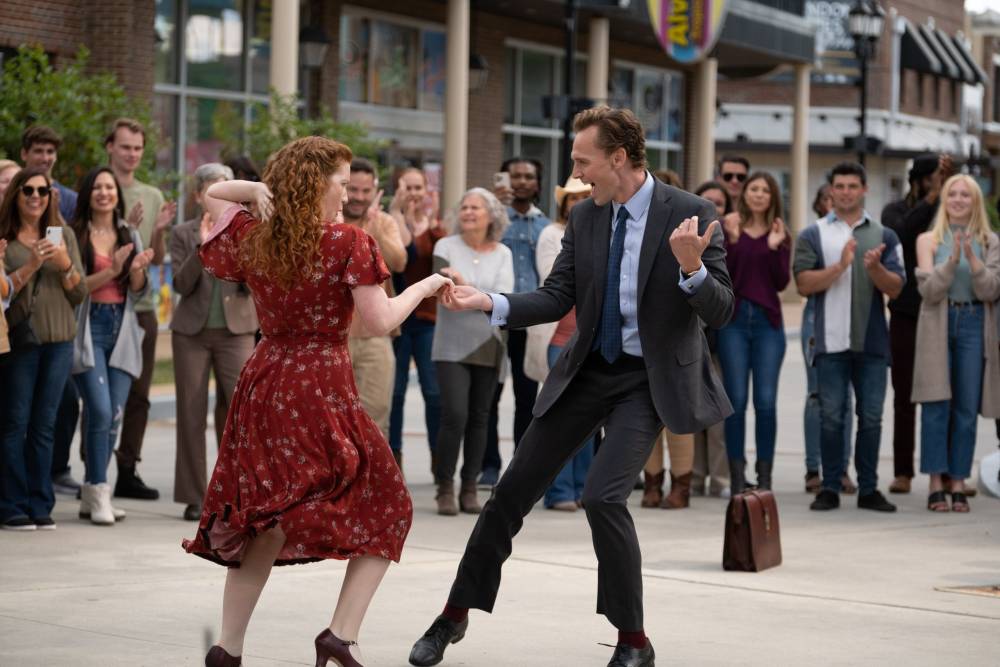
Chuck’s life, and the world he envisions, is one of hope and unexpected realities. A hopefulness of reunion and of love as the universe ends around you. The simple act of surprise in an accountant’s unexpected dance moves, and the kindness he shows to a heartbroken young woman on the street. The importance of family when faced with insurmountable loss, and the ways these little moments influence and define who you are going forward. And the daunting nature of facing down the dread of destiny, and the immense bravery of not letting the future define the present. Flanagan weaves all these ideas together (perhaps better than King himself), finding the joy, beauty, and humanity of one ordinary man’s life – and ultimately, allowing us to appreciate our own.
Of course, while Flanagan continues to prove he’s one of the best artists to adapt King’s works, he perhaps inadvertently proves his greatest shortcoming: how closely he sticks to the source material. Certain things work better in a short story than they do onscreen; similarly, certain bits of dialogue sound different on the page than spoken aloud (and dialogue has never been King’s strong suit). Moments that could be shown visually, some of King’s lesser dialogue is uttered verbatim, and the prose is often made literal by a voiceover by Nick Offerman. Even as Flanagan grows playful in juxtaposing the narrator’s commentary with the actions onscreen, it never feels like anything more than a crutch.
And it’s a shame that Flanagan feels so enslaved to the original short story, because the moments of his originality are amongst the film’s best. Flangan carefully weaves flashforwards, tiny references, and beyond into the film’s first two acts, crafting an interesting tapestry heartfelt in the moment and worth exploring on repeat viewings. Several original monologues and character beats designed to flesh out the characters and demonstrate both Chuck’s sacrifices and losses. Surely some of the runtime dedicated to devout interpretation could have been spent exploring Chuck’s adulthood and relationships. Hell, in the original short story there’s a throwaway line about Chuck’s altruism and how he saved his brother-in-law. Give us that! Flanagan gives us enough humanity to elevate the story, but there was so much room for more.
Of the four actors to portray Chuck, the strongest performance comes not from Hiddleston (who mostly portrays a billboard before plenty of internally beautiful acting in the film’s second act, in which Chuck cannot control himself from an impromptu dance with a street busker, arguably the film’s best sequence) or the SAG-nominated Jacob Tremblay (a glorified cameo), but instead from newcomer Benjamin Pajak. Pajak fills the middle-school aged protagonist with all the heart, courage, doubt, and opportunity that comes with childhood. As the film’s ostensible second lead, Ejiofor doesn’t have much to do after anchoring the film’s first act, yet his world-weary eyes, soulful monologues about humanity, and his resigned connection with an ex-wife played by a game Karen Gillan.
As one would expect from a humanist fable, the roles that stand out are the ones that feel most, well, human. Mark Hamill finds the truth in a kindly grandfather battling with his drinking since the loss of his son. Mia Sara is appropriately warm as the grandmother who gives Chuck his love of dance (and, in her little touches, gives the film’s second-best performance). Annaliese Basso is earnestly real as a woman inspired by Chuck’s dancing, Matthew Lillard outshines the material as a gregarious man facing Armageddon, Trinity Bliss embodies the girl next door, and Samantha Sloyan gives a delightfully retro performance as the gym teacher who mentored Chuck in his early days. It is a warm, bright ensemble that finds the truth in King’s archetypes.
Early on in the film, Flanagan provides a monologue reminding the audience that in the history of the universe, humanity itself barely constitutes a fraction, and our own lives wouldn’t even quantify the blink of an eye. And over the next hour, he argues that, despite this harsh reality, in this moment, in our own very lives, we, and the people around us, are everything. The Life of Chuck is not quite a great film; it just misses out on that honor. And yet it has a way of touching our hearts and engaging our compassion, encouraging each other to connect, even if all you can offer is a smile and a streetside dance.
B+
The Life of Chuck will open in limited release on Friday, June 6th, before releasing in theaters nationwide June 14th


Add Comment