
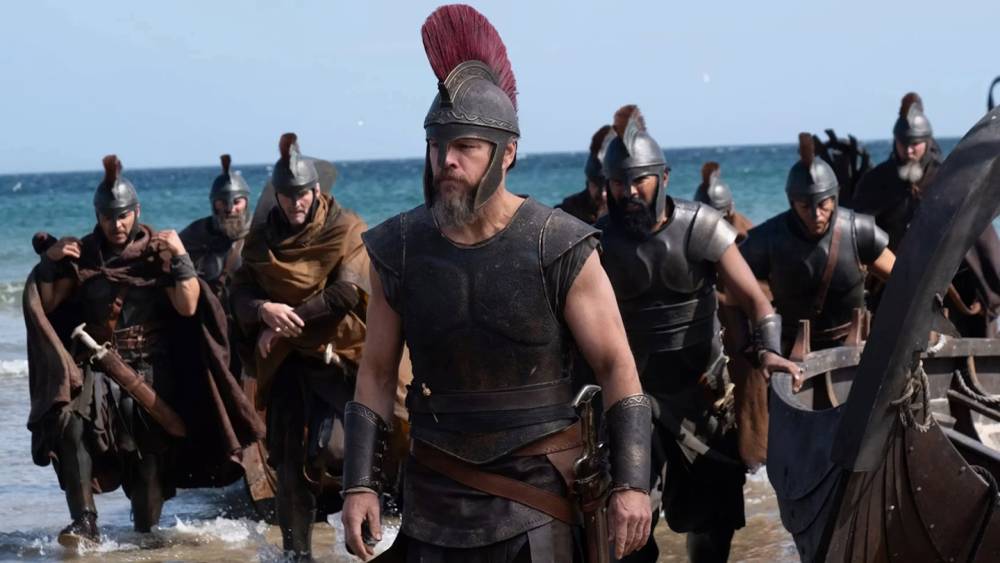
Every generation deserves its grandiose epic, the one that makes audiences gape and say “How did they do that?” Gone With The Wind, Ten Commandments and Ben-Hur, Ran, Titanic, Lord of the Rings, each blending history, art, and spectacle into an incomparable experience. Christopher Nolan has crafted many blockbusters in his career, and is fresh off his Oscar-winning blockbuster Oppenheimer. Having traversed the historical biopic, the space opera, and even the superhero genre, Nolan has now offered up his version of the epic, with the greatest story in the ancient canon: The Odyssey. And as it turns out, when you combine a master at the top of his game with one of the greatest stories ever told, the result is one of the greatest epics the screen has held in a long, long time.
It’s been 20 years since Telemachus’ (Tom Holland) father Odysseus (Matt Damon) sailed to Troy with the Greek army. While the rest of the great heroes returned to their homes 10 years prior, Odysseus never returned. In his absence, an army of suitors has laid siege to his home, hoping to marry his wife Penelope (Anne Hathaway) and become the new king, all while the queen and prince hold out hope for her husband’s return. While this occurs, an amnesiac Odysseus remains stranded with the nymph Calypso (Charlize Theron), slowly regaining the memory of the life he left behind, the war he won, and a legendary voyage home.
Homer’s epic has persevered for almost 3000 years based on the universality of the story – not to mention the grandiosity. Action, adventure, sex, violence, horror, tragedy, and catharsis. The full range of human emotions, captured in one definitive work of poetry, and destined to grapple with universal themes like fate, glory, family, and compassion. It comes as no surprise that such an epic story would make for a terrific film in the hands of a master storyteller, and Nolan is exactly that. Furthermore, he manages to find threads in the story that tie in themes present under the story’s surface, no less present and no less universal, yet somehow manage to breathe fresh life into an ancient text.
Nolan’s vision of The Odyssey dives into the story’s ideas on religion, grief, guilt, and humanity’s very nature. While the poem emphasizes Odysseus as a cocky trickster whose hubris often gets in his own way, Nolan dives deeper into Odysseus’ character. He’s still the brilliant strategist who believes in honor. Yet Nolan allows this characterization to ask not just “How did it take Odysseus ten years to get home?” but “What if it took so long because he didn’t feel worthy?”
Nolan and Damon’s interpretation of Odysseus grapples with the guilt of men he’s lost (sometimes through his own fault), the atrocities he committed in Troy and beyond, and his tacit breaking of Zeus’ Law (a proto-Golden Rule that will, admittedly, be mentioned 10,000 times). He is no less grand and honorable, but he is more self aware of his own shortcomings, and that dichotomy drives the film. And when coupled with Telemachus’ journey of discovering a father he never knew and become a man worthy of his legacy, it crafts a dual narrative worthy of the gods.
Of course, while audiences deserve a blockbuster this weighty and thoughtful, we all know what brings them out is spectacle. Thankfully, Nolan delivers this with abundance. The Trojan Horse and the Sack of Troy, Polyphemus the Cyclops, man-eating giants, massive whirlpools, these are all images burned into the collective imagination, and yet Nolan finds a way to reinterpret these stories in ways never seen before. And when coupled with practical sets and effects, and filmed entirely on IMAX cameras, it creates a visceral, undeniable experience audiences have rarely seen before.
The massive armies and walls of Troy as it topples to the ground. A cave of horrors as men are picked off one by one. The haunting silence of the Gates of Hell, or an island of sirens beckoning one to doom. The expert buildup of treacherous men described as priests, or of a worn-down man preparing to exact vengeance for a long-suffering wife. Each of these sequences masterfully unfolds in the hands of a team at the top of their game (from costumes and production design to sound and score), rivaling the great works of DeMille, Kurosawa, and beyond. It’s an astonishing achievement, one that plays on every emotion as your jaw remains thoroughly on the floor.
The acting, admittedly, never exactly feels like the mold has been broken for the epic genre; yet at least the performances remain on par with the star-studded affairs of The Ten Commandments and Spartacus. Damon wears his stoicism well, breaking only for two emotional cathartic beats. Holland, meanwhile, gives the best performance of his adult career as a young man trying to establish himself as both a man and king. Most performers make the most of limited screentime with haunting performances, like John Leguizamo, Lupita Nyong’o, and Samantha Morton. Others opt to chew scenery, like Robert Pattinson and Corey Hawkins (both excellently smarmy).
The only performance to feel truly remarkable comes from Anne Hathaway, playing the oft-forgotten role of Penelope. If The Odyssey has a beating heart, it is Hathaway’s commanding performance. Subtle and controlled for most of the film as she balances running a kingdom she’s not meant to rule with a series of monstrous, abusive men looking to wed her not for love, but for power, as well as a husband who may be dead, Hathaway does a great deal with her eyes and her emotions, only breaking once she’s been pushed to her limit. The third act belongs to her, and it elevates the film to its own greatness.
It’s hard to refer to The Odyssey as anything other than a staggering accomplishment, the kind that deserves a massive audience to suit its massive scale. At this point it’s hard not to imagine Nolan weeping, like Alexander, for there were no more worlds to conquer. This is the history of storytelling and filmmaking playing out onscreen, a gamut of emotional experience. By the time you reach the film’s climax (admittedly exhausted – the film never feels long, but you feel the weight of this journey), you still find the energy to laugh, cheer, and weep. Because that’s what great films do, and that’s what The Odyssey achieves.
A+
The Odyssey is now playing in theaters nationwide. See it on the largest screen possible


Add Comment