
One of America’s most challenging love affairs in cinema is the investigative thriller. From All The President’s Men to The Insider to Zodiac to Spotlight, the genre strikes a difficult balance with the movie-going public. On the one hand, it provides the uplifting story of ordinary people like us doing what is right in the face of insurmountable odds and emerging morally victorious. On the other hand, it often forces us to grapple with ugly truths about ourselves that we may otherwise wish to overlook: that the man we unanimously elected President in 1972 was nothing more than a cheap, abusive crook, that we have allowed the tobacco industry to spend godless amounts of money to manipulate and kill us, that any one of us is capable of being a serial murderer, or that we allowed human beings on the basis of faith to systemically molest young children for decades, if not longer. The Report tackles this same inner conflict with a touchy, controversial subject: the fact that the United States unequivocally and objectively engaged in torture from 2001-2007 thanks to CIA manipulations and misinformations. But despite these uneasy truths, the film utilizes a combination of cracker-jack filmmaking, even-handed political finger-pointing, and the honest bluntness of naming names to elevate itself as one of the best films of the year, as well as the most important.
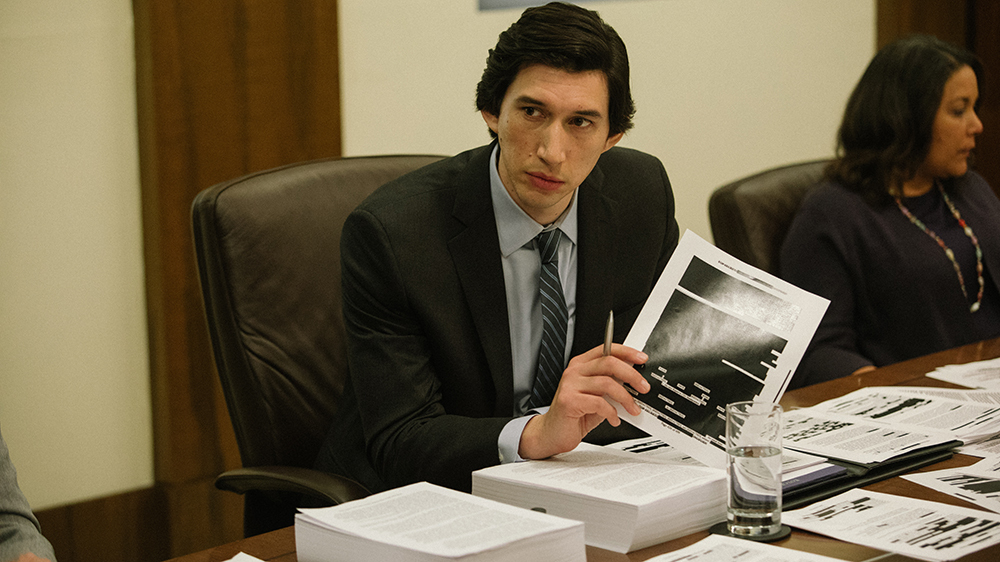
In 2009, Senate staffer Daniel J. Jones (Adam Driver) is tasked with continuing his work looking into the erasure of tapes surrounding the so-called “enhanced interrogation techniques” used by the CIA. What he finds is far more intricate than anyone could have ever guessed: a history of lying to the Executive and Legislative branches for unlimited power, brutal and ineffective techniques designed by two discredited psychologists, and the greatest misuse of power from any country in almost fifty years. Determined to bring this information out the proper way (i.e. no leaks, no whistleblowing), Jones hands over his findings in a massive 7,000-page report to the head of the Senate Intelligence Committee Dianne Feinstein (Annette Bening) for immediate and proper release. However, the team soon finds themselves locked in a bureaucratic – and highly illegal – battle with both the CIA director John Brennan (Ted Levine) and the Obama Administration, led by Chief of Staff Denis McDonough (Jon Hamm).
The strongest aspect of The Report is the way writer/director Scott Z. Burns understands that these films live and die on their ability to get audiences to care about the sleuthing that goes into the story. We love seeing reporters and detectives put together pieces of a puzzle that will reveal wrongdoing, and we just wait for that last morsel of information to fall into their laps. Burns plays the film slow and intellectual, making you feel the ten-year journey that goes into the writing of the report, but he fills the journey in with smoking guns, shadowy figures, and dramatic memos in such a way that we cheer whenever Dan finds a random document. It’s almost a magic trick how much the film manages to get us to care about a 7,000-page document. Burns, editor Greg O’Bryant, and the ever-game cast work in tandem to bring The Report to life through dramatic monologues, reenactments, and even giant chalkboards, creating a mundane, yet effective counter to the loudness of, say, Vice. The film carefully executes each turn at the right moment to cultivate an emotional response, from the early interference from the CIA to the realizations of exactly what’s happening in the black sites to the controversial manipulations at the top – the film is quite clear that the CIA willfully misled both Bush and Obama to get what they wanted, and by the time either administration was fully aware of what was happening, it was too late.
Each turn presents a problem to our protagonists, who must find new and creative ways of battling the powerful forces that be through whatever legal means they can, from incisive speeches in front of Congress to a controversial use of a confirmation hearing to leak info to the press. And whenever the material gets to be too much, or too infuriating (I had to resist the urge to throw things time and time again), the film offers up dark levity in the form of SERE doctors Mitchell (Douglas Hodge) and Jessen (T. Ryder Smith). Effectively two hucksters with casual psychology degrees, Mitchell and Jessen are the closest thing the film has to comic relief. In a series of flashbacks, the film demonstrates how the duo bureaucratized torture, finding new ways to redefine and receive funding from the CIA through a series of board meetings and slide shows. The two wear their smarminess well, making proud declarations of withholding rights from the men in their captivity and brainstorming new ways of beating people nearly to death. And as the film slowly reveals how idiotic and useless these techniques are, the film allows the duo to come up with a series of hilariously bad excuses that would be unrealistic if it weren’t so believable. After discovering that all the intel they’ve gathered from a victim is faulty, they dub the man a “super resistor” and explain that they’ve, in fact, discovered the truth – “The truth…that he’s lying.” By adding moments of ridiculous, sobering reality to the film, it prevents the narrative from becoming a retelling of a wordy document and brings the true horrors to life.
Of course, a picture like this can only work if the filmmaking can live up to the story. After all, there are hundreds of important stories told in film every year that get ignored because the execution is just sloppy. Thankfully, The Report is, for the most part, a well-crafted, crackerjack experiment. Burns writes and edits the film in the style of the great conspiracy thrillers of history, allowing the details to speak for themselves and just finding entertaining, incisive ways to reveal them. In fact, the influence of these classics is felt throughout, although never in a way that feels cheap or plagiaristic. Tim Blake Nelson appears as a former black site doctor who is filmed exclusively in parking garage shadow, a la Deep Throat, and whenever Bening bellows “get it right, get it done,” it is easy to imagine the voice of Jason Robards’ Ben Bradlee echoing through cinematic history. But make no mistake: Burns makes this film completely his own. He carefully structures the film as his own Report, even including a timeline feature to move things along speedily. And while I’ll admit the first twenty minutes or so are confusing, thanks to several years passing by in a matter of seconds, once the film begins taking its time, the slow moving years begins to have the proper effect Burns is going for.
Ditto for the extended flashbacks to the black sites, CIA board meetings, and more, complete with palette changes from dreary greys and blues to an orangey, hellish tinge of sin. Yes, it’s a little derivative, and the sequences are relatively imperfect, but there’s still a lot of there there. By forcing us into the rooms with the torture victims, we are prevented the delusion of separation that keeps us from empathizing and defending (“Well, I don’t know these people, and there’s a 10% chance they may be bad. I’m ok with it as long as I don’t see it”). It also helps elicit anger at the callous, borderline evil human beings that allowed these atrocities to occur – sure, sequences of CIA directors yadda yaddaing over the U.S. Code of Ethics may be ridiculous, but so is the notion that we allowed two renegade quack doctors devise hack schemes to torture people for billions of dollars. You may be invested from the first scene, but Burns’ filmmaking is so deceptively addictive that by the halfway point, you can’t look away. This is the type of lively, adult filmmaking that directors from David Fincher to Michael Mann have tried to emulate, and only Sidney Lumet and Alan J. Pakula ever successfully accomplished. Hell, you could even say it’s the film that Adam McKay believes he accomplished with last year’s Vice – despite all his pandering and sleight of hand and arrogance, The Report lays out McKay’s claims in a far more honest, exciting way than his lazy-ass satire ever did.
However, what draws us into The Report most of all is its moralistic heart. It’s one thing to show the audience a bunch of terrible things – its another to appeal to the morality within us while doing so. It’s why Spotlight won Best Picture in 2015. The Report has its heart in the right place from the jump, thanks to its moral protagonist and intelligent way of laying out evidence. Dan Jones is an American Hero, through and through, and the film shows us this not only through his tenacity, but through his catharsis – he cries while reading these documents and he can’t sleep over the inhumanity of it all. It’s the way we hope we’d react when faced with this level of terror and evil, and it’s why we’re drawn into his cause immediately. But the film also is aware that it can’t just appeal to those that already agree with its central thesis: it has to carefully make its case, through narrative and evidence. This is a filmmaking style usually reserved for documentaries and editorials, but Burns merges this objective with his piece of entertainment, to great effect. The Report makes its case quietly and intelligently, assuming that you may be in disagreement with some or all of its central thesis. First and foremost, it demonstrates the amoral, sinful nature of torture as a construct. If you remain unbothered by this detail, the film explains how many of the men held in these black sites were, in fact, unaffiliated with terrorism altogether, and the ones that were never shared a single, solitary piece of evidence that prevented another attack or caught those responsible. If that doesn’t entice you, then the film goes on to explain how this miscarriage of justice will mean that we cannot prosecute the real terrorists, as it violates the Eighth Amendment and will let them go free. And if you’re still not convinced that torturing innocent people (or even guilty ones, thus stooping to their level), then the film plays its final card: that the torture program has, in fact, provided terrorists with ample recruiting material, and completely hurts our cause and our nation. The film even takes a beat from the action to dispel the myth that the Enhanced Interrogation Techniques had anything to do with the death of Osama Bin Laden, proving that the narrative was concocted in the weeks leading up to the raid to prevent backlash over their actions. In fact, the film makes it clear (in infuriating detail) that not one single piece of useable intel came from the EIT program. It even takes a pot shot at Zero Dark Thirty for inadvertently buying into the narrative. At its core, The Report captures the duality of being an American in the 21st Century: it is an indictment of who we are and what we’ve done in the past twenty years, while simultaneously reminding us of what an aspirational, truly great American looks like.
The most damning detail about The Report is its naming of names. Every thirty seconds you’ll hear a name of someone involved with the abuse and cover-up, and slowly realize that this person is either a former major political figure, a CNN talking head against the President, or a current Trump appointee, including: John Brennan, Gina Haspel, George Tenet, Caroline Krass, Dick Cheney, David Addington, Jose Rodriguez, Denis McDonough and Robert Mueller (who was made aware by his fellow FBI agents and chose to pull them to avoid blame rather than file his concerns to the proper channels). The Report is not interested in playing a partisan game. It is clear from the get-go that there was failure across the board in regards to allowing these atrocities to occur. The Bush Administration put people in power willing to abuse prisoners without restraint, with or without the President’s approval. The Obama Administration went out of its way to cover up these atrocities and prevent the public from knowing the truth as a means of maintaining a populist appearance. And the Trump Administration has allowed these people to be put back in power, providing an opportunity to let these things happen again. This is not a matter of politics or “business as usual” behavior. This is a film about right and wrong, ready call out everyone willingly gave up their souls in exchange for political capital. It’s a film that keeps its protagonist squarely apolitical from beginning to end, and is ready to glorify any politician willing to stand up for justice – while Feinstein may be a major character, and certain Democratic characters believe the Republicans may stonewall the Report (which they did), the film never shies away from the Republicans who bravely took a stand. It shouts out, by name, a Lindsay Graham who was then willing to break with party to stand up to government oversight. And the film’s emotional climax comes in the form of John McCain’s now-famous speech condemning our shameful history. By eschewing itself from the partisan infighting and establishing itself as a moral compass, it makes for a better, fuller, smarter film overall.
As for the performances, The Report has one of the best ensembles of the year. Adam Driver gives one of his best performances yet here as Dan Jones, whom he plays in the style of an old-fashioned hero. It’s actually a rather interesting performance, as Driver seems to embody every Great American Actor in a way he never has before. He embodies Jones with the passion of Marlon Brando, the specific tics of Dustin Hoffman, the charisma of Tom Hanks, and the “aww shucks” honesty of Jimmy Stewart. He even throws in a dash of Jake Gyllenhaal’s memorable obsession in the terrific Zodiac. These are types and tics that I’ve never noticed from the rising actor before, and I cannot stress how effortless this performance is. As for Annette Bening, she gives a solid, is complex performance as Senator Diane Feinstein. It’s a difficult needle to thread – Feinstein is one of the most recognizable government figures in Washington these days, and her portrayal as heroic with more than a tinge of selfishness and media hunger will elicit mixed responses from all corners of the political spectrum. And yet, while Bening’s performance may not be showy, and comes laced in political controversy, it is impossible to deny that she embodies Feinstein here, for better or worse. It is a quiet, impressive performance, exactly what we’ve come to expect from the legend. Meanwhile, Jon Hamm plays Denis McDonough as charming, wishy-washy, and with an undercurrent of sleaze – so exactly what you’d expect from an Obama staffer. Still, at least McDonough can rest easy knowing Hamm gave him a little pathos – the great Ted Levine does not hold back in his portrayal of John Brennan. Levine combines two of his most iconic performances to craft his John Brennan, and they make for a fascinating portrayal; he gives Brennan the stateliness of his Leland Stottlemeyer from Monk, as well as his sadistically sleazy charm from Silence of the Lambs. It’s a terrific performance for a character who seems unaware he’s the villain in the story (his CIA lackey, for the record, is played by Dexter’s Michael C. Hall, although it’s a far less showy role). Tim Blake Nelson is his usually charming self, while Maura Tierney’s Bernadette is infuriating as a character always on the verge of realizing her own lasting harm without ever successfully preventing it. Corey Stoll shows up for a brief cameo that, like all of Corey Stoll’s roles, proves to be a good thing. And as mentioned above, Douglas Hodge and T. Ryder Smith bring to life two of the most comically loathsome, evil characters you will see on film this year. So I can’t help but call their performances successful.
At the end of The Report, the screen is filled with a quote from George Washington. It reads, “Should any American soldier be so base and infamous as to injure any [prisoner]…I do most earnestly enjoin you to bring him to such severe and exemplary punishment as the enormity of the crime may require. Should it extend to death itself, it will not be disproportional to its guilt at such a time and in such a cause… for by such conduct they bring shame, disgrace and ruin to themselves and their country.” It is a simple, efficient quote laying out the means for the United States to establish itself as a moral beacon for the world at large. History has made it clear that we have failed this beacon; there is no debating this point. But The Report is not interested in reveling in our personal failures and moral bankruptcy. It is about bringing forth the reckoning we deserve, and reminding us that in our darkest moments, there are some individuals willing to embrace the light and do what is right. As unfortunately crass as it may sound, The Report reminds me of Schindler’s List more than anything else. It is the story of a terrible abuse of power, of murder and torture, and one man’s quest to provide what solace he can. As sickening as it is that this is what our nation has become, The Report is more interested in showing us what we can be once again. And this balance of darkness of light, of sin and reflection, is what makes The Report one of the year’s best films.


Add Comment