
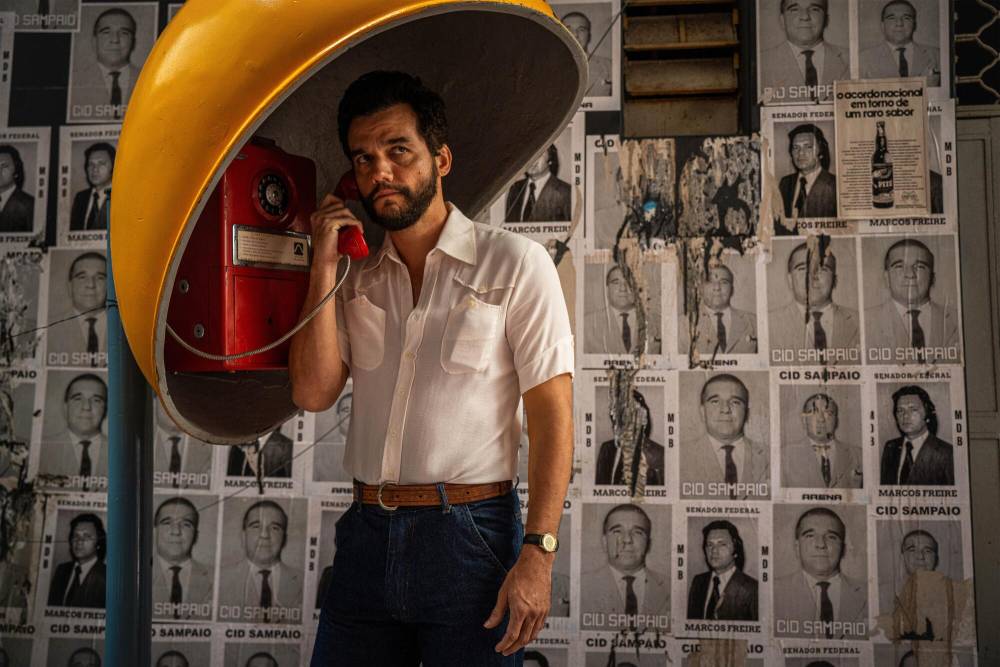
So subtly it was not, at first, perceived, Brazil has been experiencing something of a cinematic renaissance. Born specifically out of a cultural reckoning with the infamous dictatorship that ruled the country (with U.S. support) from 1964 to 1985, the Brazilian New Wave has systematically called out the nation’s darkest period, finding critical and commercial support even as Bolsonaro and his followers attempt to revive the atrocities. This culminated last year with I’m Still Here, which dominated the Brazilian box office and received several Oscar nominations. And it continues now with The Secret Agent, Kleber Mendonça Filho’s dark, yet lively thriller about life under oppression. And it stands tall as one of the year’s most thrilling films.
In 1977, Armando Solimões (Wagner Moura) returns to his home city of Recife. A mild-mannered college professor, Armando had insulted a successful businessman with ties to the government, who not only brands Armando a Communist sympathizer and wanted nationwide, but also hires a team of fearsome hitmen to hunt him down. Desperate to get across the border with his son Fernando (Enzo Nunes), Armando hides out with a secret community of dissidents, works undercover as a clerk for the corrupt local police force, and tries to find any remaining information about a mother he never knew before he ends up as one of the thousands tortured and killed by the junta.
For a film where, in theory, “nothing really happens” over the course of 160 minutes, you’ll be amazed at how lively The Secret Agent truly is. The camera glides artfully and excitedly, whilst the editing fills us in on this world gracefully. At the point you’ll check your watch excpecting the first half hour to be over, you’re already two hours in. This is a testament to Filho’s screenplay and filmmaking. By investing us in this world, with these lived-in characters (corrupt office administrators, flirty dentists, father-son assassins, etc.), you slowly feel yourself drawn into a world embodied by the strangled gasp of freedom – never overtly shown, yet constantly felt.
Filho’s film is almost episodic in nature, jumping between vignettes that capture the full spectrum of life under the dictatorship: the absurd, the frustrating, and the dangerous. The intercuts underline the irony of those who must hide – a family man, a kindly older woman, etc. – and those who thrive: sadists who become assassins, police officers with unlimited power, and so on. Filho finds little ways to show the corruption, each understood by Armando in theory but whose extent he hasn’t realized till now. “Why do I need a fake passport if I’ve done nothing wrong?” he asks, after learning that his mild slight may force him to flee the country.
Staging things from Armando’s keen, yet innocent eyes, we are allowed to witness the extent of corruption. Staged depositions so that rich ladies can get away with accidentally killing their housekeeper’s child. Hits and police intervention for simply mouthing off to the wrong person. And in one of the film’s most fanciful moments, as entertaining as it is horrifying, a literal demonstration of the true-to-life story of the “Hairy Leg,” a disembodied limb newspapers would use to covertly cover police brutality against minorities. Filho stages these reveals with the light touch of a noir and a justified anger, and through Armando’s relatable vessel, it makes for a fascinating, exhilarating watch.
As Armando, Moura gives a master class of internalized acting. While not the flashiest role, there is a great deal of life, compassion, anger, and resignation worn upon his face; it is the performance of a man who must perform to survive, as one wrong emotion or look could be a death sentence. Also worthy of praise is former seamstress-turned-actress Tânia Maria, who plays the commune founder Dona Sebastiana through curated mannerisms and a great deal of personality. Other noteworthy performances include hitmen played by Gabriel Leone and Roney Villela, underground leader Maria Fernanda Cândido, and especially Robério Diógenes as corrupt police chief Euclides – it is an expert example of the genial sadists that allow a dictator to rise to power.
The Secret Agent is the type of film that easily sweeps you away in its size and scope. It is an epic that flows easily, a searing condemnation that never feels its weight. Filho’s message is clear: there are memories stolen forever through useless violence, individuals lost forever at the feet of corruption, whose legacies can only be reflected through this film. And yet, through it all, Filho and Moura never allow the darkness to win. Even under occupation, life is about the choices we make, the people we meet, and the warmth of experiences. The Secret Agent exposes a horrific legacy many attempt to sweep under the rug. Yet its mastery lies in the way it captures the warmth of humanity – and that, in itself, is the greatest victory of tyranny.
B+
The Secret Agent is now available on VOD, it is still playing in theaters nationwide


Add Comment