
Arguably the most dangerous film one can attempt is adapting a documentary. Biopics already have to live up to the subject’s life; throw in a beloved documentary that already told the story (perhaps more effectively than a film could), and at best your film feels extraneous; at worst, unwatchable. The Smashing Machine, the solo directorial debut of Benny Safdie, and Dwayne Johnson’s first foray into dramatic acting, seeks to adapt a beloved documentary into a story about obsession and determination. The result, as one can expect, is a mixed bag. The Smashing Machine offers strong direction and decent performances, yet never feels like anything more than a paint-by-numbers story of perseverance and score-settling.
The Smashing Machine follows two years in the life of Mark Kerr (Johnson), one of the forefathers of UFC. A relatively skilled wrestler, Kerr struggles to break through and win the big one, overlooked in favor of his friend Mark Coleman (Ryan Bader), struggling with a drug addiction, and distracted by a volatile relationship with his girlfriend Dawn (Emily Blunt). As Kerr attempts to hunker down and take advantage of his best chance to make a name for himself in a blossoming industry, these forces will make an impact to last him a lifetime.
Watching The Smashing Machine makes it abundantly clear the affinity Safdie shares for both Kerr and the UFC world. While his filming of the actual fights is relatively rough (although he smartly utilizes an “audience” lens and a “reality” lens to juxtapose the human behind the larger-than-life figure), there’s a natural grittiness that can be found in his filmmaking. Like Rocky or Raging Bull, Safdie’s grittiness leaks over from the raw realities of the ring into the everyday life of a man balancing drug abuse and a broken relationship. It makes for a film that feels far more intimate, raw, and docudrama adjacent than some digitally sanitized sports fantasy.
The film is at its best when it explores the man behind the forgotten legend, the gregarious nerd behind the 250-pound behemoth. Take, for instance, an early scene where Mark chats up a little old lady at the doctor’s office after a particularly brutal fight. The scene is a master class in storytelling – it shows us Mark’s character, and allows him to explain UFC to a woman who knows nothing about the sport (and therefore, the audience – I’ll admit as someone who vaguely understands the sport it is one of the best descriptions I’ve heard to date). When the film is just a character study of a nice guy who’s good at fighting, Safdie’s skill shines through.
The problem is that, outside of moments like this, the story functions as little more than a recap. There’s no real analysis, emotional resolution, anything that could be found in the aforementioned documentary – just a series of scenes that don’t really lead to anything. There’s no insight into his psychology, or why he’s a pioneer of the sport, or why he finds himself repeating patterns. He fights, he does well, he loses, he gets in a fight with Dawn that feels like a rejected scene from The Office “Dinner Party” episode, rinse, repeat. Furthermore, there’s little to Mark’s character beyond being nice. I cannot for the life of me figure out why we have to see a grown man say “tummy” so many times in a two-hour film.
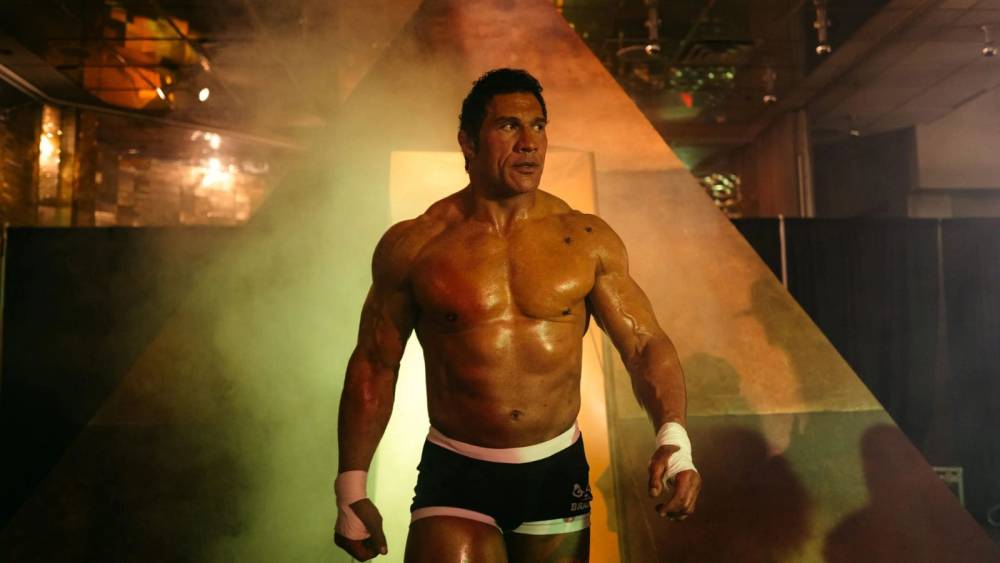
Still, despite not possessing much depth, it’s hard not to root for Mark, especially as played by Dwayne “The Rock” Johnson. While Johnson missteps whenever he’s trying to channel De Niro in Raging Bull, he does show a vulnerability as Mark that we’ve never seen from him before. He’s so talkative and fresh and nervous and desperate, allowing us to feel for Mark on his quest, and seeing him as a genuinely decent guy in denial about his life and his choices. One moment in particular, in which Mark gets uncomfortably emotional watching a Demolition Derby and relating to the car getting totaled, is surprisingly poignant. It’s a terrific performance that helps carry the film.
Blunt’s performance, however, is a lot more complicated. It is a very lived-in performance of a Jersey girlfriend (the real Dawn Staples is not from Jersey, but the choice inexplicably seems more realistic nonetheless), played excellently by Blunt. And according to reports, it is shockingly accurate to the real Staples in the documentary, including the more…shall we say colorful moments? Yet the exact methodology of doing so is inherently complicated at best, flawed at worst. Blunt and Safdie look to give a deeply troubled woman any semblance of agency, yet their only source is a retelling of events from a documentary where everyone viewed her as a toxic leech on Mark’s life. The result veers the performance into a psychotic stereotype, a dramatic version of Heidi Gardner’s Angel character from Saturday Night Live.
Ultimately, The Smashing Machine is an engaging, albeit unnecessary, drama. It has the pieces of a great film: strong performances, strong direction, a niche sport. It just feels that Safdie and Johnson failed to elevate the film beyond its initial documentary. There’s not anything wrong with that. The film is objectively fine – perhaps better than that. Yet without an actual justification for its existence – be it a history of the UFC, an unsung champion in Mark, anything beyond “Hey, here’s a guy who’s name you don’t know.” Mark’s endearing enough of a figure to warrant a film, and you’ll enjoy watching his story here. It’s just likely you’ll find yourself wanting more.
B-
The Smashing Machine is now playing in theaters nationwide


Add Comment