
I’m not sure Aaron Sorkin’s passion project, The Trial of the Chicago 7, could have arrived at a better time. The famed wordsmith’s return to the courtroom drama, Chicago 7 uses a classic story from modern U.S. history to tackle thematic moments like police brutality, contentious presidential elections, race, the death of progressivism, political reckoning. The long-awaited project’s delay to 2020 certainly makes the moral fable one of the year’s most topical, but is it any good? After all, his attempt to mansplain the news in The Newsroom was almost universally derided (although it admittedly has staunch supporters), and his directorial debut Molly’s Game failed to hit the mark. Is it possible that the man who brought us The West Wing and The Social Network had officially jumped the shark? Thankfully, these fears are completely unfounded, as The Trial of the Chicago 7 is not only of Sorkin’s best-written screenplays yet, and not only features one of the best ensembles of the year, but is also a fearless example of direction across the board.
The aftermath of the 1968 election was a strange time for America. Its most beloved leaders had been assassinated, they were mired in a controversial war, and after a milquetoast Democratic candidate won the nomination, perennial loser and notorious hippie-hater Richard Nixon became the 37th President of the United States. In league with his Attorney General John Mitchell (John Doman), the new United States government set about executing the finishing blow on the “peace and love” 60s and asserting its power against dissenters, starting with a grand showcase: charging the various factions of anti-war protesters who became embroiled in a physical conflict with police officers and National Guardsmen during the 1968 Democratic National Convention. In doing so, the U.S. government charged eight popular figures from a variety of radical movements with conspiracy to incite a riot: MOBE leaders Tom Hayden (Eddie Redmayne) and Rennie Davis (Alex Sharp), Yippie counter-culturalists Abbie Hoffman (Sacha Baron Cohen) and Jerry Rubin (Jeremy Strong), radical pacifist David Dellinger (John Carroll Lynch), Northwestern students Lee Weiner (Noah Robbins) and John Froines (Daniel Flaherty), and Black Panther founder Bobby Seale (Yahya Abdul-Mateen II). With Bobby stripped of his lawyer and locked in police custody, the seven remaining defendants find themselves in a highly-publicized political trial, armed with a put-upon defense attorney (Mark Rylance) and up against the dementia-ridden authoritarian Judge Julius Hoffman (Frank Langella) in a trial for the very soul of the American system.
If there’s one thing Sorkin is good at, more than anything else (although I loved seeing him go against-type in The Social Network), it’s watching underdogs stand up for justice against the powers that be. He cemented his legacy in doing so with A Few Good Men, The American President, and The West Wing. The Trial of the Chicago 7 is sort of a built-in slam dunk in this department, thanks to its easily-identifiable villains (the Nixon Administration), a worthy cause (Civil Rights/Ending the Vietnam War), and corruptions of justice inflicted upon those willing to stand up for Goodness, and an ultimate coming-together of those who believe in right and wrong. These themes make up Sorkin’s bread and butter, but I must commend him for handling themes he’s bungled in the past so adeptly here. Rarely has he been able to tackle the sheer level of corruption so brilliantly (he even made the decent Charlie Wilson’s War seem more like a bungled noble intention as opposed to a massive clusterf*ck). Sorkin’s writing and direction allow us to reminisce (or perhaps realize for the first time) how truly frightening this period was for those who believed in justice, thanks to the one-two punch in leadership of J. Edgar Hoover and Richard Nixon (for what it’s worth, Hoover is not named in this film, but his legacy is unmistakable).
Sorkin helps weave us through the FBI’s illegal tamperings inside the movement – from planting violent agitators inside the crowd to inspire riots to creating forged death threats from Black Panther leaders to paint them to the press as evil and get sympathetic jurors disqualified. The film really breaks down the abuses of power inside police departments – particularly Chicago’s, which both in real life and in the film stood back as frat boys accosted and assaulted yippie women, instigated the riots and brutally beat protesters, and ultimately assassinated a sleeping civil rights leader – all with smiles on their faces. And after dealing with all that, the film finds itself in a courtroom where the judge and prosecutors wilfully ignore the Constitution as they withhold lawyers, openly insult defendants, and racially discriminate against anyone Black, whether defendant or member of the public. Sorkin lets these turns and abuses build up to elicit our righteous anger, all while mirroring sympathy in our protagonists – the most heartbreaking moment of the film comes when an ardent pacifist and nonviolent protester becomes so broken by the system he lashes out in an uncharacteristic emotional state. This is the reality Sorkin wants to place us in, and he does so smoothly and adeptly.
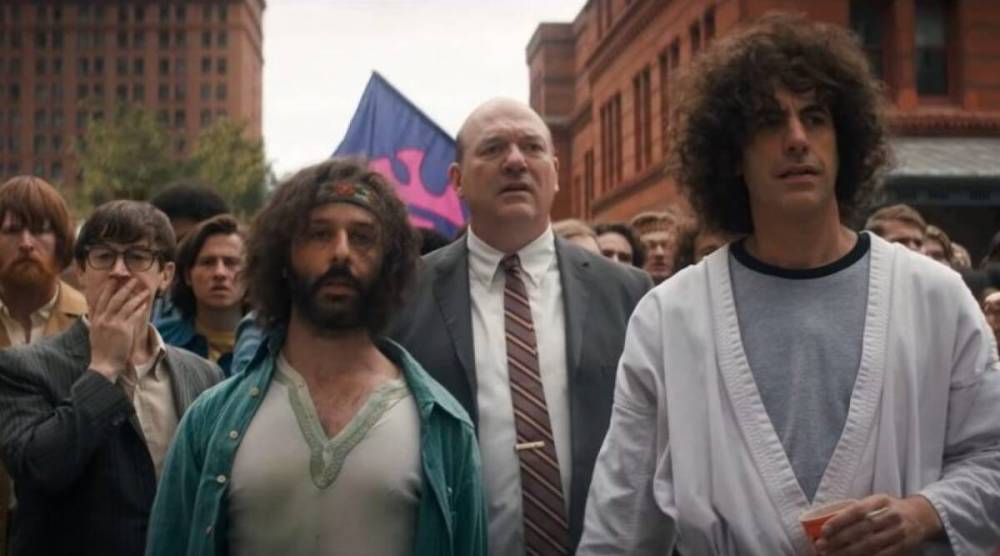
However, the strength of the film – as well as the meat-and-potatoes of its general premise – comes in the interesting, if sidelined, subplot surrounding the infighting among the Left and their ever-evolving debate on how to achieve justice. The secondary question of The Chicago 7 revolves around “Which is more successful, Cultural Revolution or Actual Revolution?” One of the best moments of the film comes in the lively, kinetic opening, which establishes not only the major issues of the time (Vietnam and the draft, Civil Rights, assassinations, poverty, etc.), but the different ideologies struggling to coexist in the same moment. In a sweeping, quick-cut sequence, we meet the clean-cut classically liberal students’ union, the iconic anarchist yippies, the anti-war, pro-equality Black Panthers, and nonviolent religious figures. It’s pretty clear the group was incapable of planning the riot they are accused of, because they are incapable of agreeing on any form of platform to fight for. In fact, the moral center of the film hinges upon what the best way to protest actually is, and the intellectual debates between Tom Hayden and Abbie Hoffman. It’s easy to scoff at Hoffman’s shenanigans, from the crazed hair and grubby look to the infamous moment where Hoffman and Rubin show up to court in judge and police uniforms as a sign of protest. After all, as several characters (including Tom) point out, these stunts will mostly alienate Americans, help Nixon win elections, and eventually drown out the important messages trying to be raised (feed the poor, end the war, provide rights to minorities, etc.).
But Tom’s not much better – while his efforts to change minds through the system may work better on Middle America, the actual change they implement is minimal. Plus, as Abbie points out, not every activist has a trust fund to support their protests – the stunts have their use. And neither group holds a candle to the Black Panthers, who actually have a reason to fight. As Bobby eloquently puts it in one scene, “You protest as a f*ck you to your father. That’s a little different from a rope on a tree.” These are questions that were relevant when I saw the film early last month, yet have benefitted from the ever-changing news cycle in unforeseen ways as the Democrats continue to point fingers in their quest to understand why they keep losing House seats, and the Joe Biden Establishment Dems engage in constant bickering with the Green New Deal liberal wing of the party. The film is at its best when its exploring these differences, and the importance of coming together for a common cause – here demonstrated by the fighting group’s joint moment of silence for those lost in Vietnam. Sorkin uses these differences as a means of critiquing identity politicking in the face of true tyranny, and it creates a fascinating, lively narrative in the process.
What’s perhaps most impressive about The Trial of the Chicago 7 is how much Sorkin has grown as a director since we last saw him. As a piece of filmmaking, Molly’s Game was a bit all over the place, as if Sorkin were just trying to mimic every director he’d ever worked with. Here, the famous wordsmith has confidently found himself as a filmmaker. To start with, Sorkin has crafted one of his best screenplays in years, filled with lively dialogue and the crackerjack courtroom drama he made his name off of, what with fighting defendants, corrupt judges, shocking witnesses, tons of information conveyed in quick, fun, smart ways, and beyond. Sure, his worst tendencies are still on display (there’s an egg bit that’s just unbearable to watch), but as a whole, it mostly holds together and works as a part of the overall fabric.
But Sorkin’s talents go beyond just the page. His work with editor Alan Baumgarten is some of the best of the year, blending together several different structures and narratives in one clear-cut format. There are several impeccable sequences which cut between real footage, recreations, Abbie’s lectures on the subject (weirdly framed as a stand-up routine, but I’m willing to go with it if the film is), and the police’s flagrantly false testimonies under oath. The four different methods complement and strain against each other with every cut, creating a smooth, flowing narrative with relative ease. Sorkin’s even willing to experiment with his cinematography, letting DP Phedon Papamichael weave his camera through throngs of protesters in flashy tracking shots. In fact, the only thing I’m not completely sold on in terms of the technical prowess is Daniel Pemberton’s early-rock score. It just never quite fits the narrative correctly. But with that being said, I’m still impressed with Sorkin’s improvements in the director’s chair.
Of course, despite all of these positives I’ve run through, I do want to make it clear that I do have some glaring issues with the film, which hinder its chances from elevating from “great” to “perfection.” For starters, if you’re an aficionado on all things Sorkin (as I’d like to consider myself), you’re probably aware of a certain…reverence for the idea of the Genius White Dude. I don’t want to necessarily get on a soapbox when it comes to narratives about Great White Guys – I still love films like Lincoln and Whiplash and First Man and beyond. But there’s something different about the Sorkinian Great Man. In particular, it’s the fact that unlike most films of its kind, Sorkin’s Genius White Man often becomes elevated through conversations with a Dumb Female or Dumb Minority. The perfect example of this is the scene on The Newsroom where the Sorkin stand-in gets in a fight with a shrill flight attendant on his quest to tell the world that we’d killed Osama Bin Laden, and the entire plane claps when he finishes yelling at her.
The Chicago 7 is no exception to this rule, and in some ways may be worse: while I appreciate Caitlin Fitzgerald’s performance here, the only three female characters of note are Naive Hippie Girl, Bitchy FBI Informant, and Black Panther Who Doesn’t Get How Great Bobby Is. It’s not outwardly offensive, per se, but it’s certainly not great optics. It’s also pretty evident with certain Bobby Seale speeches that this film was definitely written by a White Boomer/Gen-X cusper. But none of these issues is as openly egregious as the film’s finale. I won’t spoil it, but I’ll say this: the ending of The Trial of the Chicago 7 is the closest we will ever come to Full Sorkin, for best or for worse. After a series of unnecessary fade-outs, the film transitions into a sequence reminiscent of the famously schmaltzy Few Good Men finale, but without the necessary build-up required. Sure, it’s possible to get emotional thanks to the real-world weight behind it, but if you’re not easily tricked by the smoke and mirrors of Hollywood, mark my words: the last five minutes of this film are the most over-the-top and masturbatory demonstrations of overwriting and overdirecting you will see all year.
It’s a little challenging to decide where to begin with the ensemble, because it really is an entirely impressive group from the top down. Everyone seems to have their favorites right now, but if I had to pick, I would single out five performances that stand out above the rest – in order, John Carroll Lynch, Yahya Abdul-Mateen II, Eddie Redmayne, Sacha Baron Cohen, and Jeremy Strong. Each actor brings something unique to the table, and ultimately sweetens the ensemble as a whole. Lynch in particular blew me away – I’ve always been fond of the great character actor, and he steals the film here with his poignant, idiosyncratic pacifist who advocates for clean language and will break your heart before you’re done. Mateen, meanwhile, continues his meteoric rise to stardom as Bobby Seale. From the jump, Mateen makes it clear how magnetic Bobby is, and he delivers a series of monologues with impeccable aplomb. Redmayne in particular is a shock to me, as I am a well-reported anti-Redmayne canvasser (he’s not made a single good movie in a decade). Yet I was highly impressed with his performance here as a man caught between beliefs struggling to keep it together and do what’s right. He is highly convincing in each and ever scene. As for Cohen and Strong, you kind of know what you’re getting from them – they’re here to play Puckish pranksters of anarchy and justice, and they are both excellent, whether separate or as a comedy duo. I will say Cohen is a little stronger in the role, as Strong’s abilities as an actor are more suited to priggish Wall Streeters (something the real-life Rubin eventually turned into, ironically), but it’s the two of them that give this film life.
The rest of the cast is relatively decent, in one way or another. Frank Langella is solid at playing an awful dementia-ridden judge that’s slowly losing his mind, even if it is a bit of a hammy role. Mark Rylance makes for a powerful defense attorney (Ben Shenkman’s there too, holding down the fort), even if it’s not quite as powerful as Bridge of Spies or Dunkirk. Joseph Gordon-Levitt provides his role as a smarmy prosecutor with a (perhaps unearned) heart of gold pretty well – you at least see the gears turning in his head, even if the character is a bit ham-fisted. Rounding out the Chicago 7, Alex Sharp is a solid foil to Redmayne, if not overtly memorable, while Daniel Flaherty and rising character actor Noah Robbins make a joke out of how obviously out-of-place they are in this movie (they play their roles adequately, but the entire point is that they’re forgettable). Perhaps my favorite role outside of that core five is Kelvin Harrison Jr., who is simply terrific as the charismatic Fred Hampton. In fact, he plays the role so well that when he eventually disappears from the film halfway through, his absence is felt, physically and emotionally. The aforementioned Fitzgerald, for what it’s worth, makes the most out of her flawed outline of a character, and I will say that as stunty as it is, I did enjoy Michael Keaton showing up as Ramsay Clark solely for the paycheck. Oh, and the final performance I would like to praise is the bit performance of John Doman as John Mitchell. He embodies the smug assh*le so well right from the jump, and even if he is overacting, it surpassed the world of badness and enters “ham” and “camp” territory – a world I quite frankly love to see John Mitchell inhabit.
The Trial of the Chicago 7 is exciting, classical filmmaking at its finest. It’s pure Sorkin in (mostly) the right ways, and gives birth to a surprisingly strong director. It is the best type of historical drama, bringing the past to life while commenting on our present. It is a solid ensemble piece, courtroom drama, morality play, and piece of filmmaking. I’m grateful that Sorkin had the opportunity to complete his dream project after almost 15 years, and as it goes on to become an inevitable Oscar contender, it is worth remembering that underneath it all is a good story worth telling.
A-
The Trial of the Chicago 7 is now streaming on Netflix


Add Comment