
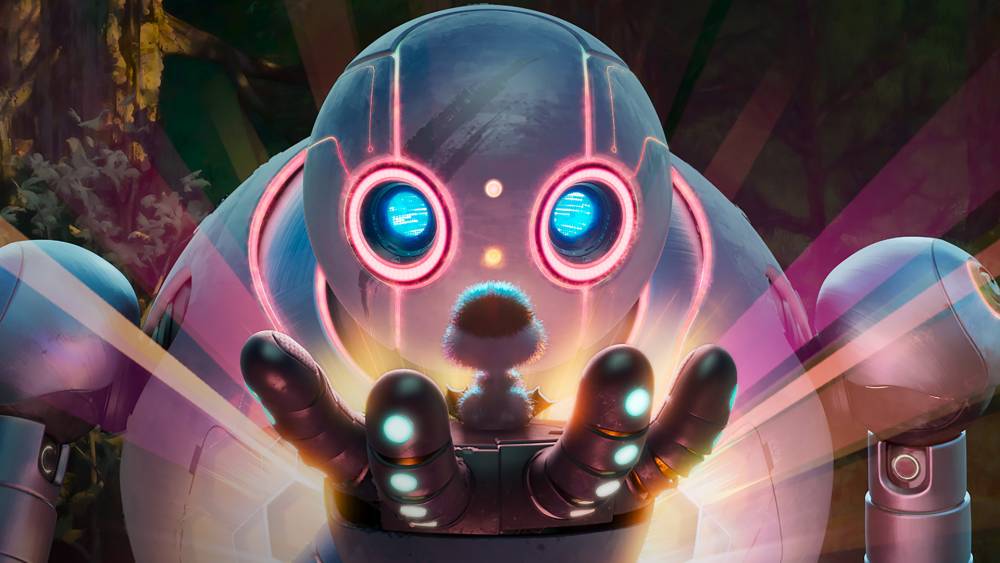
After over twenty years of both critically and commercially beloved films, Dreamworks Studios is officially kaput. That’s not to say that there won’t be any new films from the company. But for the first time since Shrek, the animation department has been shut down, electing to outsource the work to smaller, cheaper groups, effectively changing and ending the brand. So for the last in-house release for the studio, at least director Chris Sanders has sent them out on the highest note possible – The Wild Robot emerges as not only one of the best films of the year, but one of the best films from the studio altogether.
When a carrier ship crashes on a tropical island uninhabited by humans, it leaves behind the last of its cargo, including a sole ROZZUM helper robot (voiced by Lupita Nyong’o). Designed to never stop until a task is complete, yet devoid of humans to do so, ROZ (as she dubs herself), tries to find ways to survive on the island and eventually escape. It’s not an easy task – after all, the animals of the forest fear and mock her every chance they get.
However, during her trials, she accidentally destroys a goose nest, leaving only a sole survivor, whom she names Brightbill (Kit Connor). After the baby goose imprints on her, ROZ’s task drive forces her to make sure the child is capable of joining his brethren for the yearly migration in order to survive the winter. With the aid of a reluctant, cynical fox named Fink (Pedro Pascal), ROZ must teach the gosling how to eat, how to swim, and to fly. And in the process, ROZ learns about empathy, community, and even love.
Sanders has managed to find that sweet spot that makes one fall in love with the animated medium. At its best, animation finds a way to tell stories live action never could; and what’s more, it has historically served as a way to tell adult stories for the entire family. It’s what Walt Disney and Hayao Miyazaki could do best at the top of their game. Here, Sanders finds a way to utilize his premise to probe questions of purpose, motherhood, empathy and found family.
ROZ is a perfectly executed character: lovable enough despite a sense of empathy or humanity forced into the most vulnerable of all human acts: parenthood. Yes, it causes comedic misunderstandings, fish-out-of-water scenarios, and a relatability of frustration at the task at hand. But as ROZ learns to become more human, and to care for living beings outside of simple goals or obstacles in her task, she learns empathy. How to tell stories; how to be a mother; how to connect to other creatures; and yes, even to love.
It’s a simple story, and Sanders doesn’t utilize any flashy tricks to make it work. He lets the innate humanity in his tale (panicking over a child’s struggles, determination to help him grow, risking one’s own life to save others) speak for itself, and simply aids in the storytelling with impressive filmmaking. And make no mistake, this is expert filmmaking. The animation is utterly gorgeous, fluid and vast in scope, not seen in Western animation since Wall-E and Finding Nemo – hell, maybe even The Lion King.
These visuals are underscored by Kris Bowers’ terrific score, working together to visually dazzle. Look no further for proof than the sequence where Brightbill learns to fly. Accompanied both by Bowers’ score and Maren Morris’ original song “Kiss The Sky,” the visual execution of both vast skies and forests and a depiction of utter determination, tenacity, and love will sweep you away, both physically and emotionally. This is masterful work from the animation company, arguably their best since the first How To Train Your Dragon, and impressive all around.
In terms of the vocal work, the entire ensemble pulls their weight. Particular standouts include Catherine O’Hara as a tired mother opossum, Bill Nighy as the goose clan’s leader, and Matt Berry as a neurotic beaver (no greater sentence has ever been uttered). I do, however, want to praise two vocal performances in the film for their impressive weight. Pedro Pascal’s slinky, cynical work as Fink the Fox is unrecognizable, yet perfectly inflected. However, more monumental is the work by Lupita Nyong’o in the title role.
What Nyong’o is doing here is masterful work, as she is so wildly different from her previous roles as this chipper, upbeat robot. There is so much nuance in each delivery. Listen to the love and warmth she gives each line, even when she is supposed to play an emotionless (yet still lovable) helper droid. Roles and robots like this only work if you make us care, and that’s exactly what she does. She even sells the character’s self-doubt as she realizes she is becoming less robotic and more compassionate. Quite frankly, this might be one of the best voice acting performances I’ve seen in years, and it sells the film.
The Wild Robot is a staggering achievement, in terms of both animation and storytelling. It is the sort of mature story for children most studios don’t even attempt anymore, filled with heart and soul and visuals. I loved this film from the top down, from the voice acting to the script to the animation. I’m not sure what the future will bring for Dreamworks Studios. Perhaps the shuttering of its animation department marks the end of a Golden Era that gave us Shrek and How to Train Your Dragon and so many others. But if this is the end, at least Chris Sanders sent us out on a high note, a final hurrah for the whole family.
A
The Wild Robot is now available on VOD


Add Comment