
At the beginning of Tony, Matt Johnson’s origin story for Anthony Bourdain, a young, cocky Tony (Dominic Sessa) pitches a prestigious writing fellowship on his non-existent book. He dubs it a bildungsroman (which he pronounces confidently and incorrectly), a coming-of-age tale in which the protagonist leaves childhood for adulthood while learning valuable lessons that ultimately hone their craft. It’s a metatextual introduction to Tony, the story of Bourdain’s growth from a cocky little sh*t into one of the most universally recognized chefs in the world. And in its biographical bildungsroman wrappings, Tony manages to capture the genre’s high highs – whilst also steeping to its low lows.
In the summer of 1975, “Tony” Bourdain is a wastral student of Vassar College. After failing to obtain a prestigious writing fellowship, Tony runs away from home to pursue his high school crush, Nancy Putkowski (Emilia Jones), who is spending the summer working in Cape Cod with her boyfriend. Out of money and options, Tony takes a job working at The Flagship, a local seafood restaurant, and sleeping on the hammock of the enigmatic, hardnosed Head Chef (Antonio Banderas). Over the summer, Tony experiences a summer of sex, drugs, and rock n’ roll, develops a sense of discipline, and ultimately develops a newfound love of cooking.
The film shines whenever Tony is in the kitchen. Johnson captures the joyous camaraderie of a greasy kitchen run by a bunch of degenerates with keen, perceptive detail. Watching the kitchen staff drink, curse, insult, and still manage to put out quality food is as addicting a lifestyle to young Tony – and we the viewers – as the copious drugs the chefs indulge. Johnson’s camera futher lingers on the food our protagonist initially takes for granted and later gives him the life he dreams of with a passion only quantifiable as “food porn.” Shucking oysters, homemade ketchups, lobster thermidors, and beachside clambakes leave the viewers’ mouths salivating, and demonstrate fully why a half-assed job would become Bourdain’s entire existence later in life.
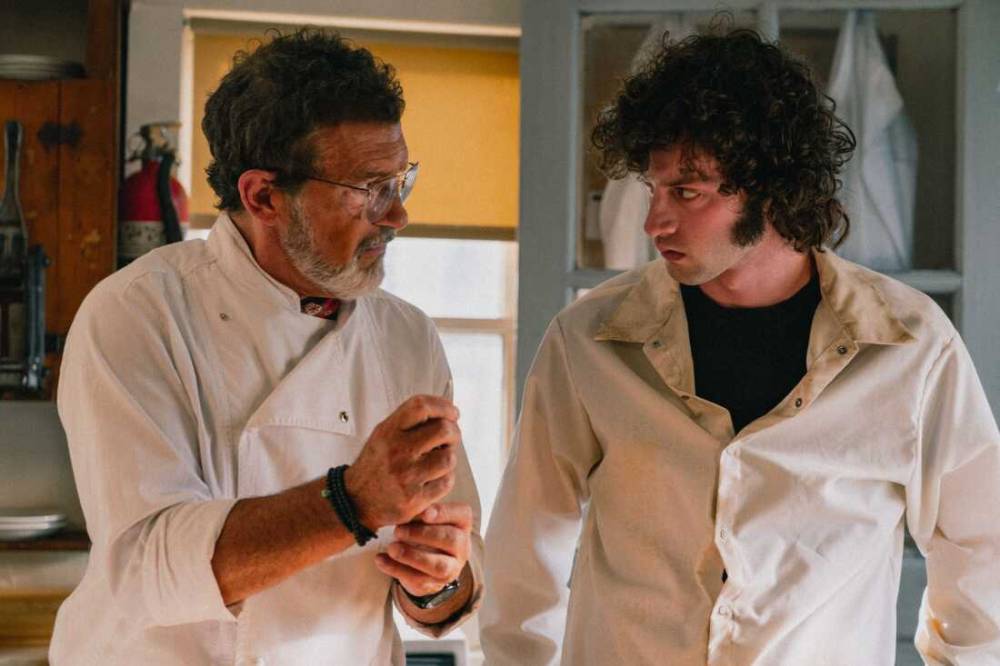
Furthermore, the film is at its best when Tony is interacting with either Banderas’ nameless chef or Leo Woodell’s unraveling dirtbag mentor Sal. Both performers bring dimensions to what would otherwise be cliched archetypes in a hero’s journey. Banderas in particular elevates the stern taskmaster who teaches Sessa’s cocky teen about structure. It’s not a role we haven’t seen before (there’s more than a little Mr. Miyagi on display), yet Banderas’ pious, talented father-figure has enough little nuances to make it pop. Woodell, meanwhile, is more of a devil on the shoulder for young Tony, and he plays the troubled, explosive not-so-mentor with a great deal of passion. Their performances also push Sessa to his very best as well, allowing him to capture Tony’s abrasive exterior, passionate interior, and a deep self-loathing he barely wants to show himself.
The same compassion and depth, however, is not replicated in the film’s two leading female characters: Nancy, played by Emilia Jones, and Tony’s condescending intellectual mother, played by the great Dagmara Domińczyk. Like most of the women of the film, they tend to fall into two toxic archetypes: b*tches or sluts. Nancy is supposedly a driving force to young Tony, based on her looks and her personality. And yet she lacks any semblance of a personality, making it all the more confusing (or insufferable) that the entire plot hinges on Tony’s attempts to f*ck her (it doesn’t help that Sessa and Jones possess no chemistry). Equally frustrating is the wasted performance by Domińczyk, who exists solely to emasculate Tony in her handful of scenes. Mommy issues explain a lot in Tony’s behavior, yet the film better shows their relationship through dialogue and Sessa’s performance, not through cliched Freudian dribble.
Scenes like these leave Tony a frustrating experience, although not an unenjoyable one. It is a mess of cliches, including some that are frustratingly asinine. Yet certain cliches, when paired together and executed by strong actors, work well. If you enjoy watching sh*tty little twerps learning about discipline and growing into worthwhile human beings, Tony will work for you. If you enjoy watching dysfunctional teams sh*t-talking each other as they create something great, Tony will work for you. But if you’re hoping for either of those stories with an original take, or anything resembling realistic expectations…just know your mileage may vary.
B-
Tony is now playing in theaters nationwide


Add Comment