
Perhaps the hardest literary styles to adapt to the big screen is the sparse, lyrical novella. For every No Country For Old Men, there’s a Hemingway adaptation that falls flat. Denis Johnson’s 2012 novel Train Dreams is one of the more beautiful books of the last twenty years, capturing a man’s life and tragedies against an ever-changing American backdrop. Sadly, the terse beauty of his work cannot be found in Clint Bentley’s (half of the team that brought us last year’s remarkable Sing Sing) adaptation, which consistently hedges its bets and in doing so, loses the wonder that made Johnson’s work pop.
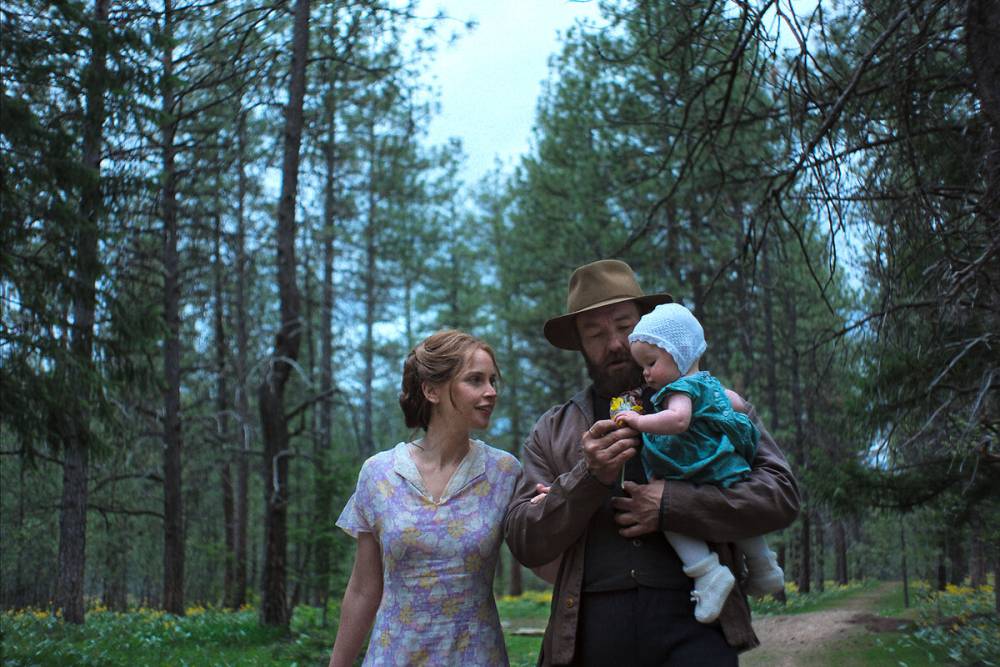
At the turn of the century, Robert Grainier (Joel Edgerton) works as a logger in the Pacific Northwest. The film reflects on his life, from his early days as an orphan to his last days in the cabin he built for his wife Gladys (Felicity Jones) and their daughter Kate. Much of the film reflects on his relationship with the nature around him, both positive and negative, as well as how his choices had ramifications he could not foresee.
Train Dreams is an undeniably gorgeous film, thanks to its lush, Malick-esque cinematography and strong helming from Bentley. And it works best when it reflects, almost from the perspective of nature itself, the passage of time and the bluntness of history. As the world continues to modernize, how does man keep up – can he keep up? And how does the world respond to mankind’s dual nature to create wondrous acts of love and horrific deeds of hatred and abuse? And how do those contradictory aspects of a nation built on a great deal of both?
Bentley is interested in exploring death, life, time, and all the mysteries that fall in between. It is a testament to the uncaring nature of history. Boots hung on a tree to memorialize workers killed on the job are seen years later, grown over with moss and ignored by the next generation of loggers. In one of the film’s few original scenes, a seemingly pious man is killed by a Black bounty hunter to avenge a hate crime. Whether the man was truly reformed or using religion as a shield matters not: time and death come for us all.
The film’s most beautiful moments explore the passage of time, the beauty of an ordinary life, and the effects of our choices. Yet Train Dreams falls victim to the greatest drawback for film’s exploring the nature of time: it feels its journey. While the novel thrives in its lyrical, almost memory-like prose, the film’s method of portraying this involves repetitiveness. A beauteous shot of nature has great effect on the audience; hundreds of them whilst breaking up an already-sparse narrative eventually dulls them.
There’s also the seemingly mismatched choices in what to take from the book, and what not to take. The choice is made to allow Will Patton to narrate the film in order to capture the film’s lyrical prose. Instead of helping emphasize sequences and bridge gaps, this decision ultimately both overexplains and undercuts the central themes. We find ourselves listening to a description of themes we’ve already witnessed with our eyes, while sequences that require backstory are left woefully underprepared.
Furthermore, there’s also the sanding down of Robert as a character. The novel Robert is a flawed man, one who makes distinct choices, both good and cruel, which speaks to the novel’s overall theme that a man’s life is the sum of his parts, not the result of any one action. Yet all of these choices from the novel are simplified. No longer is he prone to mob mentality, torn in indecision over helping evil men even out of kindness, and punished for his actions. Now his crimes involve “not acting quickly enough,” making their ultimate karmic punishment utterly disproportionate.
For his part, Edgerton does his best to provide Robert with an internal life, and he carries the film’s more intimate moments, although he faces the unnecessary burden of a character crippled by inaction – audiences can relate to a flawed character moreso than an inert one. William H. Macy is arguably the film’s greatest asset, unsurprisingly warm and vibrant as an old-timey logger. Jones’ character is underutilized (it is admittedly a small part, but should loom larger), while the great Kerry Condon shines with what little material she has to work with. Although I suppose she is but a moment in time.
Train Dreams is a film whose parts are greater than its whole. It is impossible to write this film off completely. It is a reflective look at the meaning of life, filled with decent performances and the most lush imagery you’ll see all year. Yet the film is incapable of either capturing the magic of the novella or capitalizing on its own beauty. It hopes the beauty of nature will do the heavy lifting, and ultimately makes for an utterly languid experience. The skill of the filmmaking keeps me from utterly dismissing Train Dreams outright; yet its lack of meaningful emotions prevents me from endorsing it as well.
B-
Train Dreams is now streaming on Netflix


Add Comment