
Something I’ve done on this site for quite some time, as a means of explanation for readers, as a fun little throwback, and as an analytic trademark, is compare modern directors to directors of the past. Christopher Nolan is the new Spielberg, Greta Gerwig is the new Woody Allen, Damien Chazelle is the new Bob Fosse, and so on. I say all this because, when it comes to Jordan Peele, there is no comparison. Sure, there are traits of Alfred Hitchcock, George A. Romero, and so on, but at the end of the day, he is incomparable. He is the first Jordan Peele, a modern-day master who can make a thoroughly entertaining and intelligent horror film even when he may only nail a triple when swinging for the fences. And that is the case with Us, a film that is a bit too big for all of its ideas, but is nonetheless thrilling, enjoyable, and poetic.
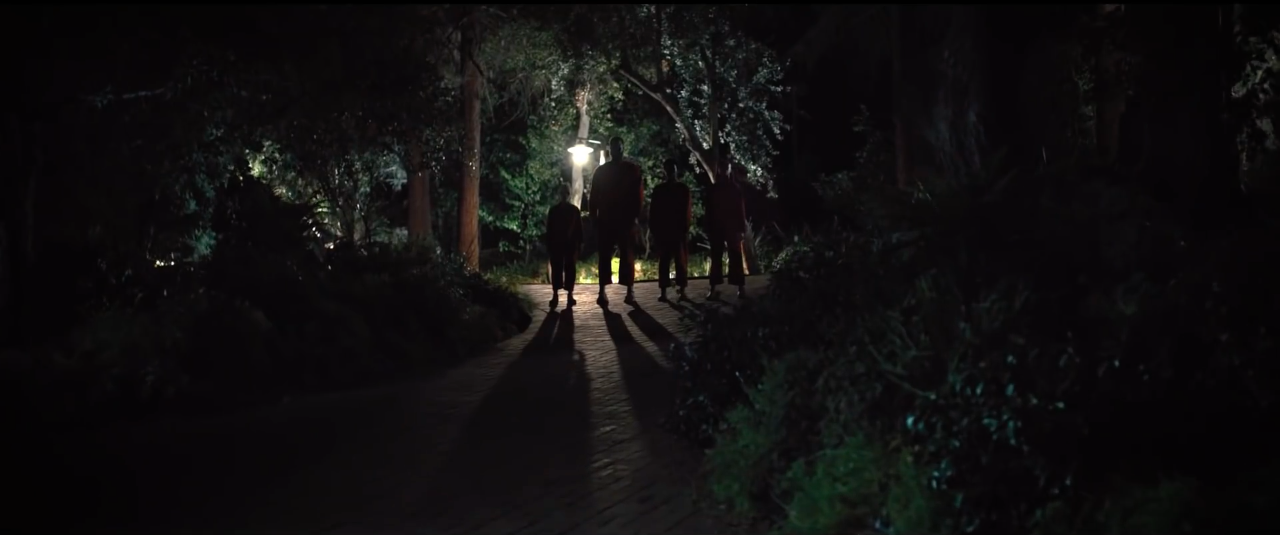
In 1986, something traumatic happened to Adelaide (Lupita Nyong’o) inside a Hall of Mirrors at Santa Cruz Pier. After twenty years of therapy and recovery, she returns to the pier on vacation with her family: dorky husband Gabe (Winston Duke), athletic daughter Zora (Shahadi Wright Joseph) and awkward son Jason (Evan Alex). However, after a day of strange events, the family faces down a terror they could never expect: another family, dressed entirely in red, who look exactly like them, who have but one goal in life: to exterminate their real-world counterparts at all costs. Now, Adelaide, Gabe, Zora and Jason must defeat Red (Nyong’o), Abraham (Duke), Umbrae (Joseph), and Pluto (Alex) to survive the night and find out why these people they share so much in common with want them dead.
What makes Jordan Peele such an iconically unique director is that everything he does is so unabashedly him. Sure, he understands the language of film enough to drop homages and references here and there – the opening feels like a straight tribute to The Omen, and Peele shares John Carpenter’s ability to emphasize scares inside the backgrounds of his images. But overall, the way he composes his films is wholeheartedly inventive. Each frame of the cinematography feels like a portrait, with the reds and oranges leaping off the screen the same way blues and blacks were emphasized in Get Out. Peele smartly uses his cinematography as a thematic guide, even when the meaning is obvious – when Nyong’o gives a heartfelt monologue in front of a mirror about what terrifies her, it is such a great shot that it is easy to overlook how obvious the metaphor/foreshadowing can be. Meanwhile, the editing keeps the film at a haunting pace, never lazily settling for jump scares, and focusing instead on ratcheting up the tension to terrifying degrees. Each scene has the complexity and the construction of choreography, from the movements of the actors to the payoffs of little moments – especially the now-infamous shot of the Jeremiah Man standing on the beach with his arms outstretched. Hell, the film even climaxes in a choreographed “ballet” sequence, set to Luniz’s “I Got 5 On It.” Speaking of the music, Peele’s soundtrack work is second to none, even beyond the haunting score of Michael Abels. Peele understands music enough to reference the times of his films’ settings while never feeling dated or forced. The idyllic opening features Janelle Monáe’s crowd-pleasing “Make Me Feel,” while a later scene breaks my heart (in a good way) by utilizing The Beach Boys’ “Good Vibrations” as an ironic bit of juxtaposition – the same way Insidious used “Tiptoe Thru The Tulips,” Silence of the Lambs used “Goodbye Horses,” and The Exorcist used “Tubular Bells.” Oh, and there’s a great use of a certain N.W.A. song that I won’t spoil here. And of course it’s not a Jordan Peele film if comedy isn’t woven into the fabric of the film. There’s an Amazon’s Alexa joke that shouldn’t work but inexplicably does – and quite well. There’s a repeated joke involving a flare gun that has the perfect payoff. And in the film’s tensest moments, Peele stops the action to have the family get into a silly, honest argument over who has the highest “kill count.” And while the final “twist” is pretty textually obvious (I figured it out in like half an hour), that doesn’t make it a necessarily bad twist – it still works even if you see it coming. This is just a perfectly constructed film, from beginning to end.
However, the film’s strongest and weakest moments come from further analysis into its deeper themes and questions. While Get Out was a straightforward film that opened up on further criticism (to brilliant effect), Us starts out broad and hopes to narrow down its subject as it goes on. A lot of the bigger questions Peele grapples with here have some weighty undertones: the central idea of grappling with past grief and trauma is certainly an interesting one, as is the ultimate story of our past sins coming back to haunt us – just as Adelaide and Red come to terms with a horrific choice from the 80s, so too must we grapple with the repercussions of our own decisions in the modern day. However, the film does choose to expand past its initial premise of “the enemy is The Inner Me,” to quote one of our greatest modern philosophers. And when it does so, Peele starts to lose his tight grip on the narrative and socio-political undertones on display. While there is certainly something going on, as can be read in the ever-present Jeremiah 11:11 (not just a fun play on the 11:11 motif) reference. To summarize Jeremiah 11:11, the Lord is so infuriated with the state of the world, he will allow evil to ravage the community, and will not listen when they beg for his forgiveness. It is clear that the uprising of The Tethered (the doppelgängers determined to murder us all) are meant to represent something. The problem is, Peele is working so broad, that the Tethered could truly be anything. You could make a successful case for The Tethered – people who look like us that have lurked under the surface for decades before setting out to destroy all of humanity – are Trump supporters, neoliberals, immigrants, the poor, and more. There are signs throughout defending each of these scenarios – when Adelaide screams out at Red, “Who are you people?!?” Red responds, in a fairly on-the-nose moment, “We’re Americans,” the Tethered emerge from the sewers to overthrow the higher classes, and they cross our borders as a certifiable Other. But there doesn’t seem to be a sense of understanding of what they should represent. And Peele’s visual clues don’t seem to say much either – there’s a recurring rabbit motif that clearly means…something, but isn’t quite crackable, even with the added hint of one brown bunny in a field of white. There’s the fact that only the main family can figure out (or wants to admit) that these invaders look “just like us” – news reports on the subject don’t address this at all. The choice weapon of golden scissors is unique, and while it is never explained why scissors, the use of gold can be interpreted as a regal sign of wealth, thus fuelling the lower class uprising theory. And then there’s the whole Hands Across America symbolism, which may fuel the neoliberalism theory – the Tethered idolize this symbolic act that didn’t mean anything, and choose to create their own, perverse version on their own (I will say that while the Hands Across America plotline wasn’t perfect, it did lead to the best image of the entire film). I guess at the end of the day, it all comes down to who you determine to be the bad guys – if it’s the Tethered, then clearly they are supposed to be a domestic threat, determined to destroy us from within. But if the villains are the real world, and the Tethered’s mission is justified, then they must be the lower classes rising against their oppressors. It’s all fascinating to think about, but doesn’t seem controlled enough to have a clear answer.
As per usual, Peele has managed to create a murderers’ row of talent for his film, starting with the incomparable Lupita Nyong’o in the dual role of Adelaide and Red. What Nyong’o has accomplished here is nothing short of astonishing, balancing Adelaide’s calm, collected personality with Red’s authoritarian rasp. Her choices vary from small and distinct to Big And Bold, and while it would not work in the hands of a less-talented performer, Nyong’o carries this film with a performance on par with the greatest of the genre. Also fantastic is Winston Duke, who portrays the perfect dorky dad in Gabe as well as the dull behemoth that is Abraham (he gets most of the film’s laughs in both roles). Shahadi Wright Joseph and Evan Alex are both highly capable of playing Zora/Umbrae (a sassy teen and psychotic nightmare) and Jason/Pluto (an awkward geek and creepy mute), respectively. Meanwhile, Elisabeth Moss and Tim Heidecker are so perfect in their dual roles that I wish they’d been given more to do – Moss is the perfect spoiled socialite, while Heidecker manages to play rich twat just as easily as creepy lurker. It is, all in all, a great cast, and the fact that every single one of these actors has to play not one, but two distinct roles, is masterfully impressive.
Us is the best case scenario for when a director wants to outdo himself. Jordan Peele is a distinct visionary who manages to balance out his ever-growing thematic hellscape with a carefully detailed, narratively taut thriller that impresses both on a narrative and technological scale. While I wish Peele had managed to nail down exactly what it is he wanted to say, at the end of the day, it doesn’t entirely matter. He still completed the impossible task of following up an all-time great film with an equally respectable genre film. Get Out was no fluke; it was the birth of an auteur. And in that same vein, Us is its herald. It is the proof of concept establishing a modern-day legend. And it is a worthy entry in the modern-day horror lexicon.


Add Comment