
The Benoit Blanc cinematic universe has always been predicated on its social commentary. The first one touched on immigration while tackling the wealthy elites and the illusion of a power struggle when you already have it all. The second satirized the uber-wealthy failsons whose charisma and blackmail allows them to amass fortunes they’re not smart enough to earn on their own. For Wake Up Dead Man, the third Knives Out mystery, director Rian Johnson takes on the ultimate sacred cow (literally): faith and religion. His parable creates a strange quandary: while the series’ usually-tight dialogue has fallen by the wayside, the mystery, thematic center, and filmmaking have stepped up in almost every other way.
After finding Christ during a particularly difficult time in his life, Father Jud Duplenticy (Josh O’Connor) has given his life to the Church and spreading the word of God’s love. However, after an incident earns him the ire of the higher-ups, Father Jud is sent is sent to the failing Our Lady of Perpetual Fortitude. Once a shining pastor in a small, wealthy New York town, the church has fallen by the wayside over the years, thanks to a sordid town scandal and the iron thumb of Monsignor Jefferson Wicks (Josh Brolin). Wicks’ fire-and-brimstone sermon have driven away parishioners, leaving only a handful of loyal followers who have glommed onto his power.
Jud and Wicks find themselves at odds over the Church’s teachings – so much so, that when Wicks collapses dead in a locked room during Good Friday mass, Father Jud becomes the prime suspect, despite no conceivable way to have done it. Enter Benoit Blanc (Daniel Craig), drawn by an unsolvable mystery and a complicated relationship with religion, and the only hope to clear poor Father Jud’s name. The question is, who amongst the few remaining followers could have done it – high powered lawyer Vera (Kerry Washington) and her failed politician brother (Daryl McCormick)? Divorced alcoholic doctor Nat (Jeremy Renner) or conspiracy theorist author Lee (Andrew Scott)? Organist Martha (Glenn Close) or groundskeeper Samson (Thomas Haden Church)? Or perhaps…Father Jud isn’t quite the good man he seems to be.
Where Dead Man excels is in its incisive look at faith, religion, and fact. The film’s central character, Father Jud, finds himself engaged on all sides in his faith and belief. For most of the first act, this is seen in a juxtaposition of Jud’s compassionate approach and Wicks’ veiled threats and passion for power. It’s a smart exploration of the way powerful men hide their evil in the cloth of the Church, demonizing others so that when they storm off or feel insulted, you further entrench yourself with the corruption rather than side against the Church of God. Johnson carefully explores the differences between those of faith and those of religious zealotry.
Yet after Wicks’ death at the end of the first act, the film pivots to a separate, complicated exploration of faith: that of Blanc vs. Jud, two men morally aligned, yet ideologically opposed. For the first time in the series, we see a peak behind the curtain of Blanc’s personal life: his devotion to logic and science, compounded with a strained relationship with a religious mother, have left him with a foul taste for anything religious. Therefore, he cannot fathom why a man as good and as intelligent as Father Jud would be interested in what he considers “hokum fairy tales.” Their spiritual differences and approach to morality stokes the film’s intellectual center, and allow for moments of genuine emotion – a comical scene involving an easily distracted secretary gives way to real heart when Father Jud must derail the mystery to offer spiritual guidance.
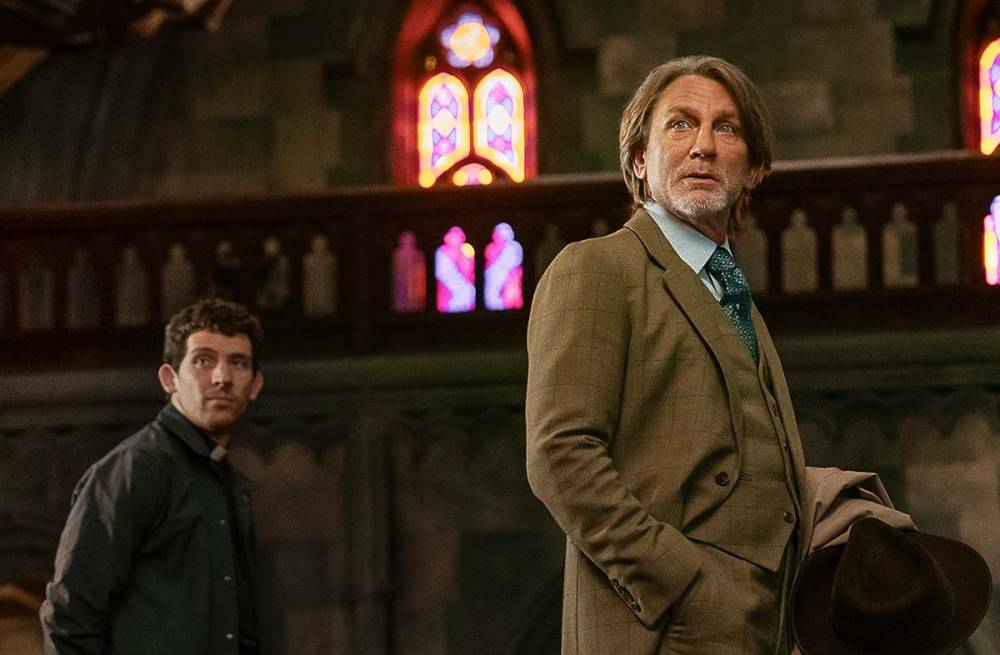
Furthermore, Dead Man proves to be Johnson’s most mature film in the franchise to date, both narratively and cinematically. As opposed to the rather obvious mystery at the heart of Glass Onion (the most unsubtle glass-switch in history still haunts my dreams), the mystery at the heart of Dead Man is alive and rich, twisting and turning in proper Christie fashion. Furthermore, Johnson steps up his own visual language to meet the story’s Gothic vibes. Allusions to Poe and some of the darker tales of the nineteenth century are alluded to, thanks to stained glass windows, perfectly timed (some may say, divine) lighting, and eerie sequences all add ambiance to the story that far surpass the dullness of Knives Out’s sterile house, or the tropical locale of Onion.
However, Wake Up Dead Man does have an Achilles’ Heel that its predecessors did not possess: the actual screenplay. Johnson has put so much effort into building his world, his story, and the weighty themes, he’s forgotten how to write convincing characters. Even as glorified cartoon caricatures of wealth and power, the characters in the Knives Out franchise have always felt like human beings – flawed, corrupt humans we often want to see fail, but human nonetheless. Here, the dialogue sounds juvenile, wooden, and disingenuous. The first 20 minutes of the film feel so tonally off and so Reddit-pilled, one worries this may be the first bad entry in the franchise. The story and the mystery help right the ship eventually, but Johnson’s imperfect script plagues the film throughout.
While Craig gives his best performance as Benoit Blanc to date, balancing ego with empathy, and Josh O’Connor continues a terrific streak of films as a kindly priest with a dark past, most of the performers are at the whim of the dialogue Johnson writes for them. Close, Renner, Washington, and Cailee Spaeny have the juiciest scenes and dialogue, while McCormack and the usually-reliable Scott struggle under the weight of their own satire. Mila Kunis is utterly miscast as the local police chief who hires Blanc. In fact, the three best performances stand out for different reasons. The first is Brolin, who manages to find humanity even in Wicks’ most stupidly written lines. The second is Thomas Haden Church, whose mostly-quiet performance shines without dialogue. And the third is Bridget Everett, whose role starts as comic relief and ends as the heart of the film.
Wake Up Dead Man continues Johnson’s streak of well-structured, entertaining mysteries. While it is easy to wish the dialogue were tighter, or perhaps the film was slightly shorter, there is too much to appreciate in Johnson’s film. It is darker in tone, yet lighter in touch; Gothic in nature yet with a bright, undeniable hope. Is it as ambitious or intelligent as, say, last year’s Conclave (the most recent exploration of faith and religion that’s also very, very funny)? No. But it’s still a warm, witty film that, for the first time in the Knives Out franchise, possesses a sense of timelessness. And it makes for a good film overall.
B
Wake Up Dead Man: A Knives Out Mystery will premiere on Netflix Friday, December 12th


Add Comment