
When a director reaches his apex, one can begin to notice their traits, trademarks, and cliches. Sometimes, a director reaches this zenith in masterful fashion, like Quentin Tarantino did with Once Upon a Time in Hollywood. Other times, it makes for the epitome of annoying, like most recent Aaron Sorkin films. In the case of Wild Horse Nine, Martin McDonagh is clearly playing his greatest hits. Depressed hitmen in a historially resonant place like In Bruges? Check. Animals that represent a higher power like Banshees of Inisherin? Check. Grappling with national sins like Three Billboards? Check. Catholicism juxtaposed with excessive cursing like…well, all of them? Check check check.
Despite blending all of these ideas together, Nine isn’t necessarily better than any of McDonagh’s previous outings. Although being fair, what could be as great as In Bruges or Banshees? But thanks to a smart script, a killer third act, and two unparalleled performances from leads John Malkovich and Sam Rockwell, Wild Horse Nine is still at least as good as its predecessors – or at least, worthy of the conversation. And when added together by the sum of its parts, it emerges as one of the better films to release in 2026.
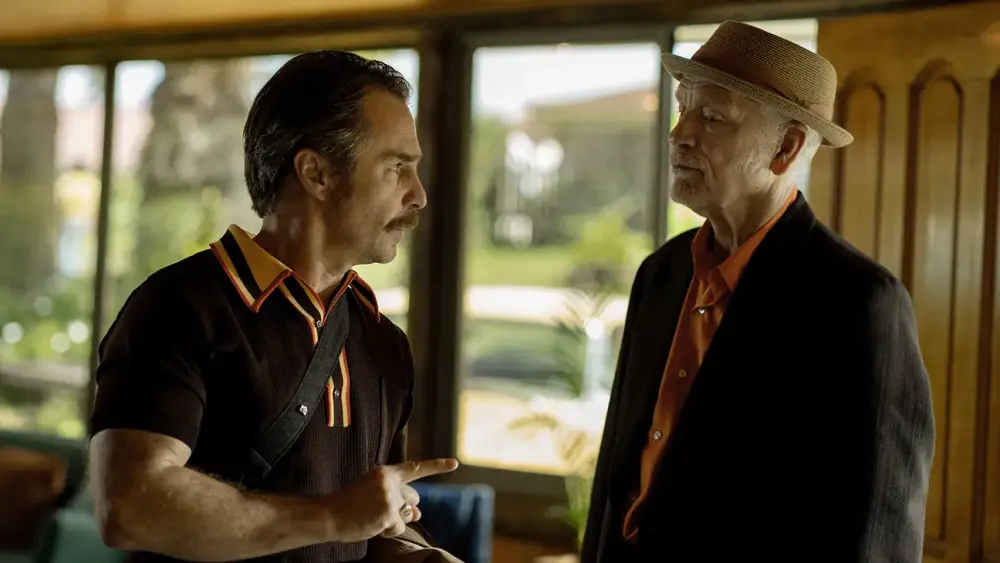
In 1973, CIA operatives Chris (Malkovich) and Lee (Rockwell) work in Chile to prep the stagework for the coming coup against democratically elected president Salvador Allende. As their bureau chief MJ (Steve Buscemi) prepares for the fascist, yet U.S.-friendly Augusto Pinochet to launch is well-funded coup, Chris and Lee enjoy some downtime on the nearby Easter Island. However, the trip is far from simple. Chris is dying of cancer, and as his memory fades with the copious amounts of morphine meant to keep him at peace, his tongue becomes looser, and his Catholic roots force him to grapple with his roles in Guatemala, the Congo, the Bay of Pigs, and even Dallas 1963.
Chris has asked Lee to kill him at the end of the trip…which makes Lee’s life easier, as MJ has also ordered Lee to kill Chris, hoping to both shut him up and recover the missing evidence surrounding the Kennedy assassination. However, Lee has no desire to off his one-time mentor. And Chris, meanwhile, is forced to reconcile with his sins due to the island’s spirituality, his own faith and fading memories, a seemingly God-like encounter with a wild horse, and two Chilean student activists (Mariana di Giorlamo and Ailín Salas). The combination of events sets them all on a collision course with destiny.
For much of the first act, Wild Horse Nine feels dangerously close to full-blown repetition. While the banter between Chris and Lee crackles (primarily thanks to the performers), it just feels like material tread before. Bad men shooting the sh*t, cursing up a storm, and occasionally getting philosophical about life, death, guilt, and morality. And what’s slightly more alarming is how baseline the material appears – one of the first interactions is the duo recruiting a priest to give volatile homilies that sew division amongst the Chileans. Meanwhile, the film’s first recurring joke is Chris and Lee’s annoyance (and perhaps even malicious hatred) whenever someone corrects their use of Easter Island with the “indigenous” name. Whether a Boomer joke, a British joke about Americans, or an attempt at topical humor, it falls short of McDonagh’s usual heights.
However, by the second act, Wild Horse Nine comes alive, largely thanks to two benefits of the writing. First and foremost, once the duo falls into a rhythm where we recognize their tics, traits, and internal struggles, their rapport becomes stronger and the jokes become smarter. We begin to relate to these two even despite knowing they are possibly devils incarnate. The second, and more pertinent, is the way Chris evolves as a character. A bygone of a different era, Chris’ sordid history and his grappling with it as he faces down mortality represents a nation grappling with its own horrific actions.
It’s easy to forget while looking at the doddering, rambling, affable performance by Malkovich (truly one of his best, capturing so much weight and horror behind increasingly forgetful eyes) the truly evil things this man has done. In a series of soliloquies, usually presented to a tape recorder but also delivered to Monica, the student he feels most drawn to, Chris lays out every democracy he’s overthrown in the name of freedom, from Guatemala to Africa.
Chris’ description of murdering Patrice Lumumba, the famous diplomat whose death destabilized the continent for a century, is as chilling as his casual description of exactly how Pinochet will take power and begin mass murdering civilians in the name of Western freedom. These monologues are some of the best writing in McDonagh’s already-impressive career, and as they get more viscerally angry (not just at the CIA, but at Pinochet, the KGB, and any organization that enforces fear and power), the film only grows stronger.
Of course, this is not just a droll history lesson, or reflection on the evils of the past. McDonagh has structured a good comedy (it really is a very funny picture), yet more importantly, a taut thriller. Ironically, despite McDonagh’s strengths, the best filmmaking comes when the film amplifies the spy storyline. Mysterious cars silently trailing our protagonists. Double and triple crosses leaving characters and viewers alike wondering who to trust. The slow creep of Pinochet’s army as the CIA looks on approvingly. It makes for a rollicking good time, and while Nine may not be McDonagh’s best-written film, or best edited, it is at the very least his best directed feature to date.
As is often the case with a McDonagh film, the performances are top-notch. Enough has been written about Malkovich’s lovable monster, but Rockwell is every bit his equal. His deliveries, inflections, faces, and beyond are so good, equally infuriating and endearing as he grapples with a dilemma he doesn’t want any part of. Buscemi, meanwhile, remains incapable of giving a bad performance, balancing his buffoon of a bureau director with a legitimate sense of malice.
The female characters, meanwhile, tragically do not have as much nuance, although the performances are at least admirable. Giorlamo in particular can provide a great deal of emotion with just her face. And it’s hard not to feel like living legend Parker Posey is wasted in a small part as Lee’s cheating alcoholic wife. But on the other hand, she gets to describe how she f*cked a former clown, so maybe it’s all worth it.
Wild Horse Nine is a ball of thread, unfurling slowly at first before becoming an uncontrollable force of nature. It says a great deal in its simplicity, and emphasizes the importance of good stories, good direction, and great acting. It’s the type of emotional filmmaking that can appeal to any type of viewer: those who want weighty stories, those striving for philosophical meaning, or those just looking for some fun entertainment. Wild Horse Nine may not be the best film McDonagh has ever made. But it certainly is his most complete, and perhaps the most completely him. And we’re all the better for it.
B+
Wild Horse Nine is now playing in theaters nationwide


Add Comment