
The reason I consider documentaries to be a different format altogether from traditional narratives is the overall purpose. While narratives are meant to entertain with the capacity to inform, documentaries are meant to inform with the capacity to entertain – a form of journalism, if you will. They are designed to provide what print journalism never could, a visual connection to people and places one might not otherwise see in order to build empathy.
Of course, where the mediums overlap is the magical world where the entertainment and information equalize for a perfect experience. And such is the case with Will & Harper, a film which sneakily uses a superstar’s clout to humanize his friend, show the contrasts of this great nation of ours, and opens the audience’s eyes to an experience they may not otherwise know.
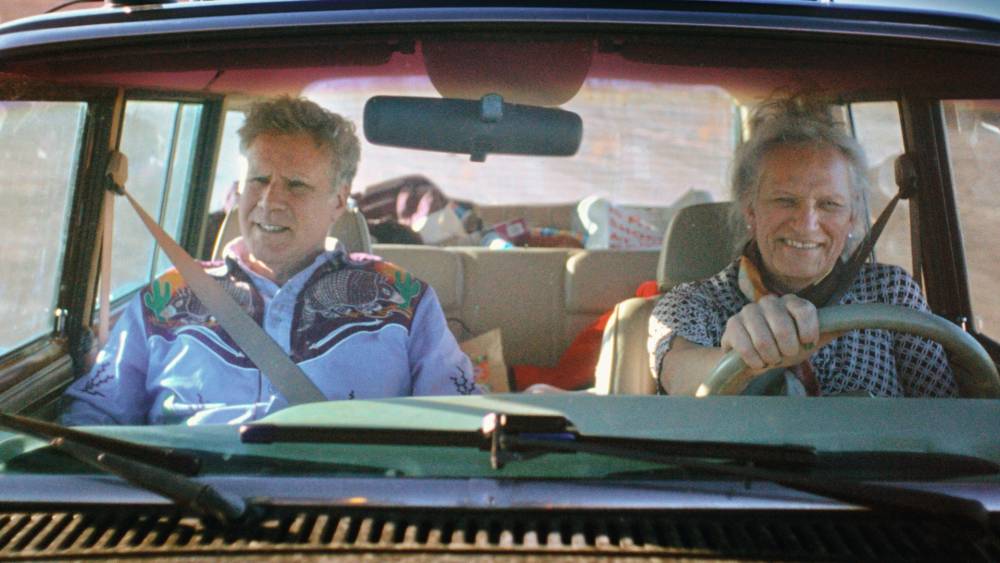
In the late 90s, when Will Ferrell blew up to the superstar comedian we know today, he befriended a writer who created most of his most iconic sketches (and strangest films). After over 20 years of friendship, that friend shocked him by sending an email coming out as trans. Now known as Harper Steele, her transition, for the most part, goes smoothly. However, she laments the fact that she likely will no longer participate in her favorite pastime: cross-country road trips with several stops at dive bars inside decidedly transphobic states.
Wanting to support and aid his friend, Will proposes they take a road trip together, and record their interactions for a documentary. His reasoning is twofold: first, that the odds of a dangerous encounter will be astronomically lower with a cis white superstar and camera crew in tow; and second, that by utilizing his everyman appeal and humor, Will can ask questions that the average Midwesterner may have in a way that can humanize and shine a light on his best friend. And as the film goes on, we get to know Harper, a woman who spent most of her life in both the background and in the wrong body, and empathize more with her journey.
The heart of this film is the real, honest friendship that Ferrell shares with Harper. They have that type of rapport that only comes from 25 years of friendship, where they know exactly the type of joke the other is going to make, and you allow them to make it with a begrudging smirk. You want to spend time with these people, because they feel real and vulnerable and human.
And yet, despite how long they’ve known each other, it also feels as though they are meeting each other for the first time. While Will knows Harper’s hobbies and quirks, there was always a part she hid from the world, torturing herself in the process. These are two friends finally seeing each other eye to eye, and it is lovely to witness.
Furthermore, because of how deep their friendship runs, the film can subtly address the more political and social nature of the ordeal. Being trans should not be a villainized status, and yet even amongst allies against transphobia and bigotry, the fear of offending kills any attempt at connection. Harper allows Will to ask any questions he wants about her journey, and while Will’s questions are often asked with a lovingly oafish glee, he also asks surprisingly incisive questions to humanize his friend to the viewers.
By asking straightforward questions with a twinkle of a joke, Will is asking the questions an average Midwesterner (the kind they interact with on their road trip through Indiana and Oklahoma) might want to ask, yet small-town life limits their opportunities. And by responding with equal parts insight and witty banter, Harper not only humanizes herself to viewers who may have never met someone like her, but also helps create understanding with the viewers at home, from the deep sadness she felt while hiding to the process of her transition.
More touchingly, the film offers glimpses of hope and acceptance in a world that seems increasingly determined to make enemies of The Other. Yes, there is a horrific moment in Texas where one of Will’s antics draws attention to the pair and earns great amounts of transphobic ire. But it also demonstrates how communication and camaraderie can change hearts and minds. In a moment of terror-turned-comedy, Harper enters an Oklahoma dive bar draped with Confederate flags and F*ck Joe Biden/Trump 2024 signs, only to find acceptance through the joys of drinking cheap beer and vibing out. As Harper notes, “I’m not afraid of these people. I’m afraid of hating myself.”
Will & Harper is a wonderfully warmhearted film. Yes, it opens eyes to an experience many viewers won’t be familiar with. Yes, it is a plea for love and acceptance in a time when that feels increasingly unlikely and hate permeates. And yes, it is a fascinating journey through a gorgeous country of contrasts as a person seen as different by vast pockets of the nation. But above all, it is a story of friends; friends who find themselves again and certify their bond no matter what happens. It is a lovely film, and a lovely way to spend two hours.
B+
Will & Harper is now streaming on Netflix


Add Comment