
Ed. Note: I viewed Wolfwalkers in late September as part of the Toronto International Film Festival. I held off reviewing it until its theatrical and Apple TV+ release
Hand-drawn animation is a lost art form. While Disney and Pixar have been on a roll in recent years, and have broken ground with CGI renderings, they just don’t have the same visual wonder associated with the paintings and artistry of classical animation. It’s one of the reasons that Wolfwalkers, the newest film from Cartoon Saloon (The Secret of Kells, Song of the Sea, The Breadwinner) is so impressive – but it’s far from the only one. Tomm Moore and Ross Stewart have crafted an artistically and thematically rich modern-day fairy tale that is not only a treat for the entire family, but is sure to make Disney jealous for years to come.
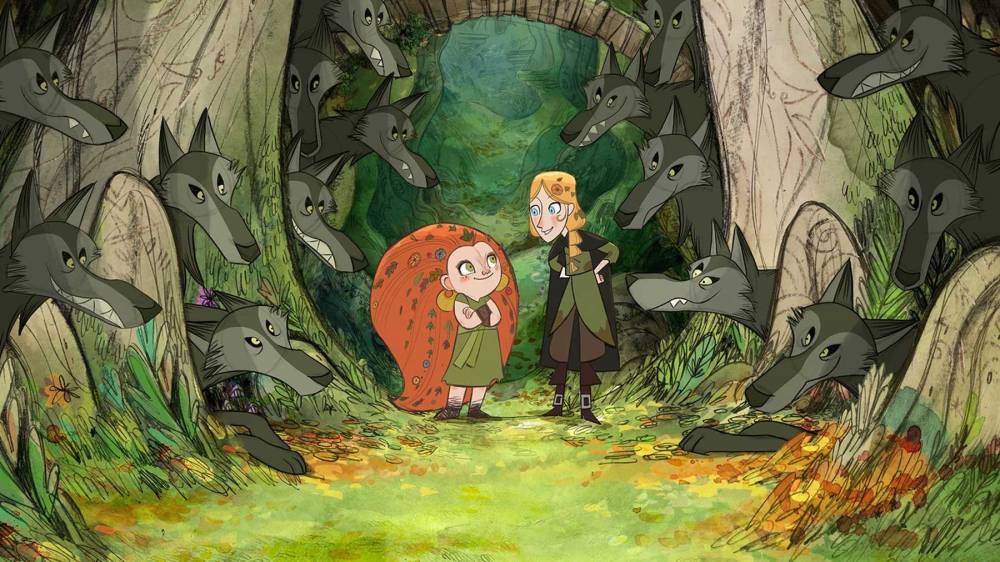
In 1650s Ireland, Robyn Goodfellow (Honor Kneafsey) moves to a small village with her father Bill (Sean Bean). Bill is a master hunter, and has been employed by Lord Protector Oliver Cromwell (Simon McBurney) to rid the nearby forests of any and all wolves that threaten their herds of sheep – as well as any indigenous pagans who supposedly worship the wolves. These pagans are known as Wolfwalkers, and legend has it they have the magical ability to not only heal most injuries, but to transform into wolves themselves at night while they dream. Robyn dreams of hunting wolves herself, but when she stumbles across a pagan named Mebh (Eva Whittaker), both lives will be irrevocably changed on a collision course with destiny.
At its core, Wolfwalkers is about intolerance, and the hatred of the Other that comes about from Puritanical groupthink. It’s no shock that the film’s choice for the villain is Oliver Cromwell, a genocidal maniac so loathed in his own time it became tradition to dig up his corpse to execute him over and over again. Like Beauty and the Beast, Bambi, and Princess Mononoke before, this is a children’s fable about what happens when people’s fear and Man’s inherent destructive tendencies impose a tyrannical belief system on the world around them. The film draws these comparisons to everyone, from Native Americans to the Irish, in ways both metaphorical – the drummed-up hatred of the pagans and the wolves – and literal. One of the film’s most subtly brilliant moments exemplifies the English-Irish divide, as Robyn has trouble making friends because her father works for the “Lord Protector.” As the other children point out, “The Lord Protector put my father in chains!” The film explores how fear, faith, and beyond can become twisted into agents of genocide, as early fear of wolves and beliefs that “Work is prayer” and cleansing the forest is “the Lord’s will” transforms into Cromwell’s toxic prayer that “This wild land must be purged and civilized, just as You will.” And the intolerance and violence expands beyond just towards indigenous people – Wolfwalkers represents a touching look at how the Puritanical era of industrialization (all the way through today) bred a culture of violence against nature. The film takes ample time in demonstrating overfishing, overlogging, overfarming, and beyond – and not for the good of the growing villages, but for the Lord Protector’s personal pocket and lavish banquets. It is this rape of Ireland’s natural resources that Wolfwalkers proudly stands against, and what puts it in the same category as Hayao Miyazaki in terms of thematically rich storytelling.
I’d also like to emphasize the sheer whimsicality of Moore and Stewart’s story, which stands firm in the grand tradition of Irish fairy tales. There’s a wondrous sense of originality that doesn’t exist in animation at the moment – truly only Princess Mononoke and How To Train Your Dragon in recent memory. Wolfwalkers draws upon traditional fairy tale storytelling techniques to bring its story to life in a fanciful way. After all, the core of this story is the odd couple-esque friendship between the wolf-hunting English girl Robyn and the wild half-wolf Mebh. They make for an iconic duo, thanks to Robyn’s relatable protagonist and Mehb’s humorous chaotic energy (she pretty much steals any scene she’s in – I’m hard-pressed to think of another animated protagonist like her, even Nausicaӓ or San). It does, of course, help that Kneafsey and Whittaker have such expressive, inflective voices that bring their characters to life. The wolf transformation sequences are breathtaking storytelling (and even more striking in terms of animated accomplishment – more on that in a minute), and manage to deliver a real sense of magic necessary for a film like this to work. The filmmakers even draw from the classic Disney formula without ever tipping over into kitsch – there’s a hilarious side character voiced by Tommy Tiernan whose entire schtick is being comically trapped in the stockades, and he may in fact be my favorite. Sean Bean makes for an emotionally strong overprotective father, and his journey helps elevate the film’s emotional core. And McBurney plays Cromwell as a properly frightening blowhard that’s easy to root against. Which reminds me – while the point of the movie may be living in harmony with nature, and life’s delicate balance, I do have to say the righteous comeuppance from the film’s final act, while historically inaccurate, is incredibly cathartic nonetheless. This is a film that knows what audiences want in a fairy tale, and finds new ways to explore the format while still delivering (and exceeding) expectations.
And to drive home the film’s majesty, there’s the fact that it’s one of the most visually striking animated films in recent memory – at least since Spider-Verse. Wolfwalkers has a unique animation style, combining traditionally hand-drawn frames with a sort of woodblock styling popularized during the 1600s in Europe. By combining the techniques, the film manages to craft lush scenery that Disney used to pride itself on. It’s been a long time since nature looked this good in 2D. But what most impresses me is the way Moore and Stewart take this art form and push it to new heights. Some of the imagery seen here remains unparalleled in any animated film I can think of. There’s a remarkable sequence where the POV shifts from Robyn’s viewpoint to Mehb’s and the ordinary townsfolk suddenly become monstrous the way wolves once were to Robyn. There’s a breathtaking astral reflection of both wolf and human personalities that is unlike anything I’ve seen before. And all of these images are edited together in fascinating, original ways – I can’t remember the last time I’ve seen split-screen utilized in an animated film, if ever. And all of these images are accompanied by a quiet, soft, intelligent score (that is occasionally poorly mixed) by Bruno Coulais and Kila – not to mention the incredible sequence scored to Aurora’s “Running With The Wolves.” This is a technically impressive, visually perfect animated film that continues to push the genre to new heights.
Wolfwalkers is an animated fairy tale the likes of which Hollywood just doesn’t make anymore. I guess that’s the circle of the business: there’s always someone new to knock you off your perch. Walt Disney was unseated by Don Bluth, Bluth by Miyazaki, and now Miyazaki by Moore and Stewart. This is the type of animated film you want to watch with your children. It’s intellectually taut without ever losing its childish wonder. This is the family film of the holiday season you won’t want to miss, and it’s easily one of my favorite films of the year thus far.
A-
Wolfwalkers is now playing in select theaters, and will premiere on Apple TV+ on December 11th


Add Comment