
Few novels have captured the world’s attention quite like Emily Bronte’s Wuthering Heights. Released in 1847, the Gothic novel has elicited strong emotions with its portrayal of ghosts, sexuality, violence, revenge, class struggles, and beyond. Timeless in this manner, adaptations have come and gone ad infinitum, from the 1939 classic with Olivier to Andrea Arnold’s recent, intimate adaptation, in an attempt to engage with new audiences of the next generation. Now, Emerald Fennell (of Promising Young Woman and Saltburn) has marked her own adaptation, starring Margot Robbie and Jacob Elordi. And it is unclear if there has ever been an adaptation that swings so wildly between profound understanding and raising questions of the writer/director’s literacy.
At the tail end of the eighteenth century, young Catherine Earnshaw (Robbie, played as a child by Charlotte Mellington) lives alone with her father at the vast, windy estate of Wuthering Heights. Once a noble family now falling into squalor, Catherine’s drunken father (Martin Clunes) returns home one day with a young orphan, named affectionately by Cathy as “Heathcliff” (Elordi, Owen Cooper as a child). From the start, Heathcliff and Cathy are inseparable, despite the young boy’s lower social standing. As they grow older, their love begins to mix with lust, complicated by the arrival of Edgar Linton (Shazad Latif), a wealthy neighbor and potential suitor. Through social standards and a painful misunderstanding, Cathy chooses Edgar over Heathcliff, leaving Heathcliff to run away to make his fortune, only to return when he’s ready for revenge.
I will start by making it clear that my issues with this adaptation have little to do with the drastic changes Fennell has made to the original story. Indeed, some of my favorite decisions involve bold choices she makes in streamlining and articulating her story. Moments like eliminating older brother Hindley to emphasize Catherine’s loneliness and transferring his abusiveness to Mr. Earnshaw. Or the film’s brilliant adaptation of Isabella Linton (Alison Oliver), who in the novel is a near-nonexistent abused pawn and here is transformed into not only Linton’s ward (creating a Heathcliff-Cathy mirror), but also a Cecile-esque character of agency in surprising, complex ways I won’t spoil here.
No, the issue is that the film amplifies the novel’s subtextually erotic themes without tying them into the actual narrative of the novel. Many films have succeeded in modernizing classic texts, whether by incorporating bold cinematic choices (like 2019’s Little Women or 2006’s Marie Antoinette), or by addressing themes only inferred in the original texts due to their shocking nature (2024’s Nosferatu). Yet Fennell demonstrates a deep misunderstanding of the themes of the novel. She fails to grasp the flighty nature of Cathy, or the driving passion of Heathcliff. And while the class commentary – the ultimate critique present in the novel – is present (thank God), it is muted, almost deliberately. Fennell’s interest in an eroticism that is, at best, merely subtextual in the novel, and at worst implies she read Bridgerton and adapted the wrong book.
Partially the film’s sexuality doesn’t work because of the way Fennell frames the relationship – Heathcliff may be passionately in love with Cathy, the screenplay and Robbie’s performance never indicate anything beyond lust from her. Yet it also fails due to the ways “Wuthering Heights” both chooses to go extreme…and the ways it doesn’t. This newfound eroticism admittedly works at times. There’s a hard cut from young Heathcliff mending his wounds after a beating into the adult Heathcliff’s scarred, muscular back. But oftentimes, it is drawn from faux-salacious imagery, like hands running through moist objects, or watching servants get down. Even when Fennell veers from the novel and allows the two to consummate their passion, it postures to sexuality through entirely chaste measures. It is an attempt at horniness without ever understanding what makes the story horny.
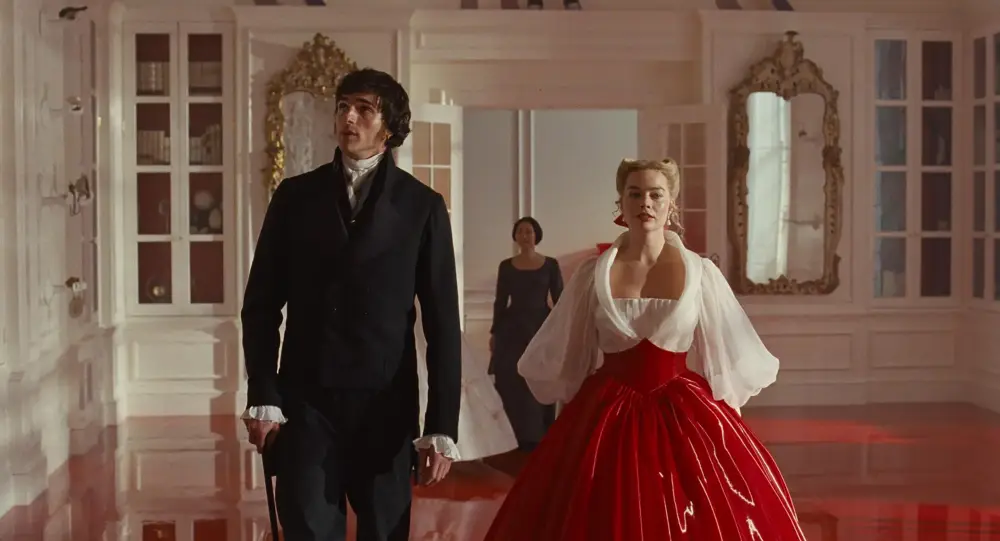
At the very least, where Fennell fails in storytelling, she makes up for in pageantry. Working with an all-star creative team (Linus Sandgren on the camera! Jacqueline Durran on costumes!), the film can often get by through sumptuous VistaVision moors, expansive foggy mansions, and sets oozing with character. Compare the idyllic, sterile Thrushcross Grange with the always freezing, always grey, violent halls of the Heights. Action is propulsed by original songs by electropop superstar Charli XCX – some songs work, others are a distraction. Truthfully, the film’s best moments are those taken verbatim from the book. Acting, cinematography, writing, the film is at its best for Cathy’s infamous monologue, Cathy’s supposedly-perfect life, and Heathcliff emerging from the fog a hauntingly changed man.
Speaking of Heathcliff, the film’s best performances come from its two depictions of English literature’s greatest character. Young Cooper brings the same brooding energy that made him a star on Adolescence, yet it’s Elordi who is the real star here. He is capable of capturing both Fennell’s vision of a shirtless, unbound figure of pure emotion as well as the restrained Heathcliff who returns for revenge. His quiet, observing eyes are some of the actor’s best work, and while he’s not quite as embittered or twisted as his literary counterpart (which is odd given the film’s belief in its own nastiness), he is perhaps more honest to the character’s reality.
This is not quite the same for Robbie – while the actress (who doubles as a producer) is remarkable during a tearful confession after a proposal, and occasionally captures the flighty, pent-up nature of Catherine Earnshaw, she never fully grasps the extent of Cathy’s nature; it’s a rare miss from one of our greatest actresses. No, most of the film’s best performances come from the sweeping ensemble. Clunes’ aggressive, drunken Mr. Earnshaw is a memorable standout, while Oliver’s Isabella is truly remarkable. She plays the role as She’s All That mixed with a litany of corrupted wards from Victorian canon. It shouldn’t work, and yet it truly does.
And then there’s the film’s portrayal of Nelly Dean, one of the strangest choices, yet not entirely ineffective. The novel’s narrator (oh, for fans of the book: “Wuthering Heights” eschews the novel’s flashback structure, so there’s no ghosts to be found) has long been infamous amongst fans, deemed in one of academia’s most famous essays “The Real Villain of Wuthering Heights, a viewpoint seemingly lost by telling the story linearly and seemingly taking her tale at face value. Yet Fennell, and especially actress Hong Chau, find a new angle on Nelly, staging her as, yes, a voice of reason, but a vindictive, bitter one at that, wholly jealous of Cathy and yet fully aware of her bullsh*t. It’s not a perfect interpretation, but Chau’s keen presence makes it interesting.
“Wuthering Heights” (and yes, that is how it’s styled) is a well made, yet utterly incomplete take on an immortal text. It certainly takes big swings, but never accomplishes its goals. It’s not horny enough, not emotional enough, not twisted enough for the vision inside Fennell’s mind; indeed, many of the film’s most sensual moments elicited laughter in my screening, not eroticism. It is a film that believes deeply in the novel, yet never tries to grapple with the very themes and narratives it portrays. By the time the film concludes with a clip show montage, it feels clear how empty it all seems. There is a modern Wuthering Heights out there that yearns to be told. Despite the best efforts of the cast and crew, it’s just not this one.
C
“Wuthering Heights” will premiere in theaters on February 13th


Add Comment