

Sacred Walloween continues to plug along, and that means a whole new listicle to keep us entertained. You know, Halloween is a time for scary movies and horror flicks, there’s no denying. Be they slashers, ghosts, aliens, or nature itself, this is the month we look at films designed to terrify us to our core. But what of the films that weren’t designed to scare us, but did anyway. Whether intentionally or not, there’s a whole subsection of films that chill us to the bone, and yet aren’t designed to be horror films. So today, I thought we could explore this phenomenon in a little more depth with the Ten Scariest Non-Horror Films Ever.
What are the criteria for such a broad-reaching list? Well, I would define these films as “movies not designed to solely or intentionally scare us, but do anyway.” They could be dramas with terrifying elements. They could be films allegedly for children that are deeply and unsettlingly terrifying. Or they could be films that were designed to be sweet and innocent and instead inspired nightmare fodder.
I’ll give you some examples. In terms of scary films meant for children, there’s Coraline’s child murder, or Chitty Chitty Bang Bang’s Child Catcher, or The Brave Little Toaster’s…well, everything. In the documentary world, Jesus Camp and Deliver Us From Evil are meant as explorations of subcultures and the darkness inside humanity, respectively, and yet something in them inherently rubs us the wrong way. Films like Raiders of the Lost Ark, Seven, Fatal Attraction, and Pan’s Labyrinth aren’t technically horror films, but you’ll find yourself screaming more times than you can count.
Meanwhile, there are also ordinary dramas that creep their way under our skin with way-too-realistic depictions of real-world horror, like 2015’s Room(kidnapping) and Happiness (pedophilia). And then there are the films that thought they’d be cute and fun, and yet technology and poorly chosen plots make them nightmarish, like the terrible puppetry in The Garbage Pail Kids Movie, the entirety of Return to Oz, and the rule-defining Uncanny Valley masterpiece The Polar Express. None of these films are technically horror, and yet all of them chilled us to the bone. So now that you understand the rules, let’s take a look at the scariest films that were never meant to be scary.
Cats
I mean, I don’t know what else I need to say to kick off this list. Cats is nightmare fodder. The CGI enters the uncanny valley more often times than you can count – why do some cats wear clothes while others are wholly naked, with human hands and feet but also tails with no genitalia? Why are they all competing with each other to die? Why are they screaming these songs, somewhat off-key, while staring directly into the camera? And WHY. ARE. THEY. ALL. SO. HORNY?!? I mean, look at Jason Derulo in this still:
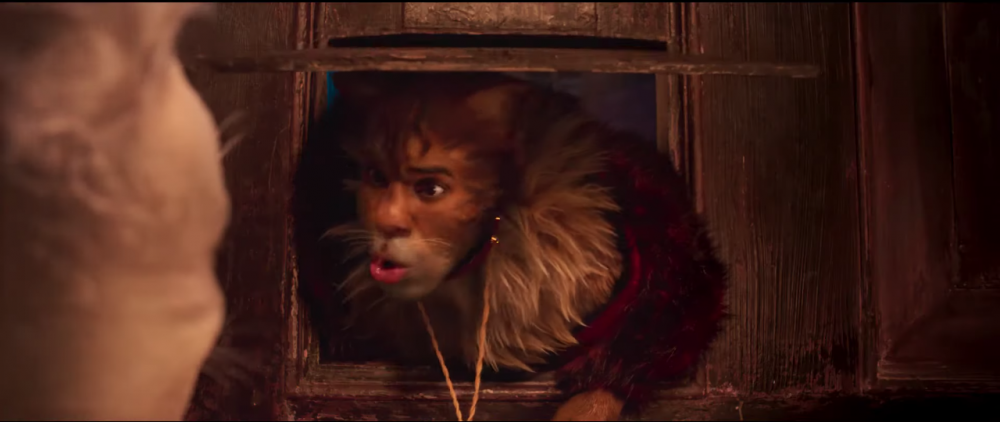
That image has haunted my dreams, along with similar scenes where Derulo tries to suck on Victoria’s (Francesca Hayward) toes, Rebel Wilson unzips her skin and proceeds to eat an army of singing, dancing mice children, and a moment when Ian McKellen slurps milk straight out of the bowl. Maybe it’s not an exact horror film, but Cats has all the terror and tension of your average slasher. Don’t buy into the claims that it is for children.
Contagion
Perhaps scarier now than it was when it was first released, Contagion has always been a “scary” not-scary film. It was considered a decent thriller when first released in 2011. Now, ten years later, let’s take a look at the plot one more time. There’s a disease, that originated in China due to some incident involving a bat, that was brought over to the United States, where it is spread through coughing and touching surfaces, and the U.S. government is torn between telling people to social distance and a coordinated effort by the White House to encourage people to go out shopping for the holiday season. Meanwhile, a hack “journalist” makes a name for himself by convincing people that a made-up chemical is actually the “cure,” and the government doesn’t want you to know. Yeah, that’s terrifyingly prescient, and watching it at the start of the pandemic was uhhh not a great choice on my part. But each segment is equally terrifying, from Jude Law’s callousness to Gwyneth Paltrow’s surprise death to Matt Damon’s emotional efforts to keep his teenage daughter – his last living relative – alive in this terrifying new world. Originally just a scientific thriller, Steven Soderbergh inadvertently made one of the scariest films of all time – and he wasn’t even trying.
Dr. Seuss’ How The Grinch Stole Christmas
Many of my millennial counterparts are convinced that Jim Carrey’s 2000 holiday flick Dr. Seuss’ How The Grinch Stole Christmas is a feel-good, funny Christmas staple. I expect nothing less from the generation brought up during one of the darkest periods in American history. This is not a fun, silly children’s film. It is nightmare fodder. Carrey’s Grinch, as flamboyant as he may be, is far more terrifying, especially because he looks directly into the camera with that heavy makeup work, staring into our souls. Meanwhile, the production design – and especially the makeup work on the Whos – veers so far into the Uncanny Valley, it wakes up our internal Death Complex. Human faces don’t look like that! Why is everything so manically edited! Who thought children would like this! Am I writing all this as a concerted effort to defend the nightmares I had as a child because of this very movie? Perhaps. But I would argue that if you took the average child, devoid of claims of “funny family classic,” they would find the makeup work and set design of this movie to be soul-crushingly terrifying. And you will not convince me otherwise.
The Imposter
It is rare for documentaries to create a sense of terror and dread. I didn’t expect to feel those emotions when I watched The Imposter early in the pandemic last year. But here we are; with a film filled with twists and turns that starts out tragic, becomes ironically optimistic, only to become devastatingly terrifying by the end. The film focuses on a family whose young son went tragically missing many years ago, desperate to find their missing boy. Cut to France, where con artist Frédéric Bourdin tries to escape police custody by pretending to be the missing boy, Nicholas Barclay. He looks nothing like the child, but the family invites him in without question. For a good portion of the film, the question seems to be, “Frédéric seems to be sociopathic. What is he going to do to this poor grieving family?” But without spoiling the twists and turns, your sympathies will, by the end, shift irreversibly. Blended between dramatic recreations and open (yet questionably honest) interviews, The Imposter starts out as a tragicomedy and ends as a nightmare.
Jurassic Park
Jurassic Park is probably about as close to horror as this list is going to come. While on a story level it isn’t as interesting as, say, E.T. or Raiders, Jurassic Park might honestly be Spielberg’s finest outing as a director. It is the perfect blend of the big-budget adventure film and the psychologically taut Hitchcockian thriller. Every choice Spielberg makes as a director establishes character and wonder, which will eventually give way to tension and terror. The mixture of puppetry and CGI on the dinosaurs not only makes the big reveal a true marvel – it holds up better than any of the World sequels around today. The original T-Rex sequence, from the shaking glass of water to the peering eye to the eventual Jeep race, is perfectly constructed. And when the Velociraptors enter the compound and turn the film into a haunted house/slasher thriller (both Samuel L. Jackson’s death and the Velociraptors opening the door to inspect the kitchen are top-notch), the film feels as close to a horror film as Spielberg would ever be interested in directing. Jurassic Park is a children’s adventure film at heart, but it has the mind of a horror film – and we’re all better off for it.
Pinocchio
You know, it’s funny. For all the effort that the Disney corporation has put into neutering cinema in the last twenty years or so, their original founder Walt got a kick out of providing his audiences with a wide array of emotions. For all the musical numbers and dazzling effects and romance found in his early works, one thing Disney prided himself on was his ability to scare the living sh*t out of children. This is prevalent in the Evil Queen/Hag in Snow White, but even more so in 1940’s Pinocchio. Already a dark tale, Disney found a way to keep the terror of the story while shearing some of the more…unfriendly edges (in the original the donkeys are brutally euthanized and Pinocchio is hanged). Here, we watch Pinocchio’s journey (through the eyes of a young “boy”) from one terror to the next. He’s sold into slavery by a fox and cat to a puppeteer who threatens to use Pinocchio as firewood. He gets eaten by a giant whale that chases him ad nauseum. And let’s not forget the extended sequence where a lecherous con man leads a group of young schoolchildren away to “Pleasure Island,” where they horrifically turn into donkeys before being beaten and sold to the salt mines by their captor. Say what you will about the current state of Disney films, at least Walt knew how to embrace his inner darkness.
Watership Down
Continuing down the animated children’s film rabbit hole (pun intended), let’s talk Watership Down. On the surface, there shouldn’t be anything too terrifying in this innocent story about bunnies looking for a home. But because the British are a repressed, nasty people, the end result is one of the most disturbing films (and strangely most beautiful) you will ever lay eyes on. This is a film that opens with a psychic rabbit failing to convince his community of a pending apocalypse (later revealed to be an extermination in order to build a new residential development). From there, the surviving rabbits are subjected to violent reality after violent reality – a hawk massacre, a tense and violent battle with a snare that almost kills the toughest rabbit, dog chases, gunshot wounds set to Art Garfunkel, and eventually a battle with a psychotic cannibalistic general rabbit. The film, ostensibly meant for children, plays as a bloodthirsty version of Bambi – therefore making it superior to Bambi. And as terrifying as it is for most children, it is a fantastic film in its own right.
Willy Wonka and the Chocolate Factory
The more the Greatest Generation and the Boomers try to make new generations watch their beloved children’s classics, the more I worry about their collective sanities (but then again, my generation loves The Grinch, so maybe it’s not exclusively their problem). Willy Wonka starts out so adorably, with a young boy living in abject poverty (his grandparents share a bed) trying his darndest to find a Golden Ticket and have one day of fun visiting a magical chocolate factory. It’s fun and silly, and it means meeting an all-time great Gene Wilder. And then the characters enter the titular chocolate factory. And what do they find? Death around every corner. Creepy orange people singing laudatory tunes about death and murder. Boat rides through Hell itself with quick cuts to beheading chickens. And So. Much. Murder. Children are sucked up pipes, thrust into incinerators, expanded until they explode, and shrunk down to miniature size. And our bratty protagonist? He almost gets chopped up in a fan. This is not a children’s film. It is a nightmare realm. And it should be treated accordingly.
The Wizard of Oz
Yeah, you knew it was coming. I’ll use any opportunity to write about The Wizard of Oz. And despite the whimsy, this is, at its core, a terrifying film – at least for its core audience of children. Let’s break it down, plot point by plot point. A young girl’s dog is going to be executed, so she tries to run away from home. She changes her mind, but gets trapped in a twister, being picked up into the air where she is hit on the head and chased by a witch. She lands in a world of creepy-looking Munchkins (little people dressed up in disturbing doll outfits. She is chased by trees and lions (who are eventually revealed as cowardly and cuddly), and a witch who makes it abundantly clear, through snarling teeth and ominous looks, that she has no qualms about murdering her and her colleagues. In fact, she sets fire to one of them not once, but twice. They arrive at their destination, and are confronted by a giant disembodied head, who orders them to go commit murder. And to avoid the murder, the aforementioned witch sends Flying. F*cking. Monkeys to assault the quartet, including disembowelment. And then, just when all hope is lost, they succeed in murdering the witch, melting her into a puddle. This is a disturbing film from beginning to end. But then again, if it weren’t so disturbing, would it be as memorable, or as perfect and as whimsical as it is?
Zodiac
Once again, a film you knew was coming. While I’ve praised moments in Zodiac as being all-time great horror moments before (that basement scene, for one), it’s not a film in good conscience I could call “a horror film.” Because as scary as it is, it’s not. It’s a morality play about the effects of unsolved murder on a community. It’s a detective procedural about trying to solve a series of murders. It is a character study about how obsession can ruin men’s lives. It is a historical epic. It is…so many things. After all, it is the greatest film David Fincher has ever made. But regardless of its true genre, it is impossible to deny that it has a sense of dread and terror throughout. The opening third of the movie, featuring recreations of the murders and the looming threat of a school shooting, is absolutely terrifying – the beachside murders are insanely tense. The constant threat of looking over your shoulder constantly exists for our characters. And that Basement Scene, where Jake Gyllenhaal’s cartoonist finds himself potentially face to face with the killer himself, stranded in the middle of nowhere with no one knowing his location? It is one of the scariest scenes ever put on film. Zodiac may not be a horror film, but that doesn’t mean it’s not scary.
Well, I hope you enjoyed this collection of non-horror fright fests. And I hope I didn’t trigger some deeply repressed childhood memories. Thinking about The Grinch all these years later certainly chilled me to the bone. But in the meantime, why don’t you comment below with the films that terrified you as a child (or adult, I don’t judge) that were never meant to be terrifying. I’m sure you can think of a couple. We have one more week of Sacred Walloween goodness, people. I’ll see you all on the other side.


Add Comment