
The following is a three-part series of reviews on documentaries pertaining to the 2020 Election and the current state of politics. Furthermore, it was written before the allegations and revelations came out about Matt Gaetz’s character in January and April of 2021. The original article stands as written, but with a wholehearted condemnation of the man and his actions
Earlier this week, one of the most fraught elections in recent memory came to a head, as millions of Americans gather to cast their vote for the next President (Almost 150 million ballots cast). As we watch two less-than-ideal candidates go head to head after four years of tense division, bloodshed, and a global pandemic that has ravaged our country, it’s easy to think to ourselves a series of questions: How did we get here? What is going on? And is there any hope for our broken government to fully recover? Well, three documentaries this year, whether knowingly or otherwise, tackled these questions in rather unique, massively important ways. Boys State explored how the system became broken to begin with. Totally Under Control pulls back the curtain to explore exactly how f*cked up our system is. And in the strangest of all, The Swamp explores a strangely uplifting bipartisan effort inside Washington seeking to fix some of these damages. And as the election weighs upon us, I took a look at these films to see what they had to say, how they said it, and whether they were worthwhile.
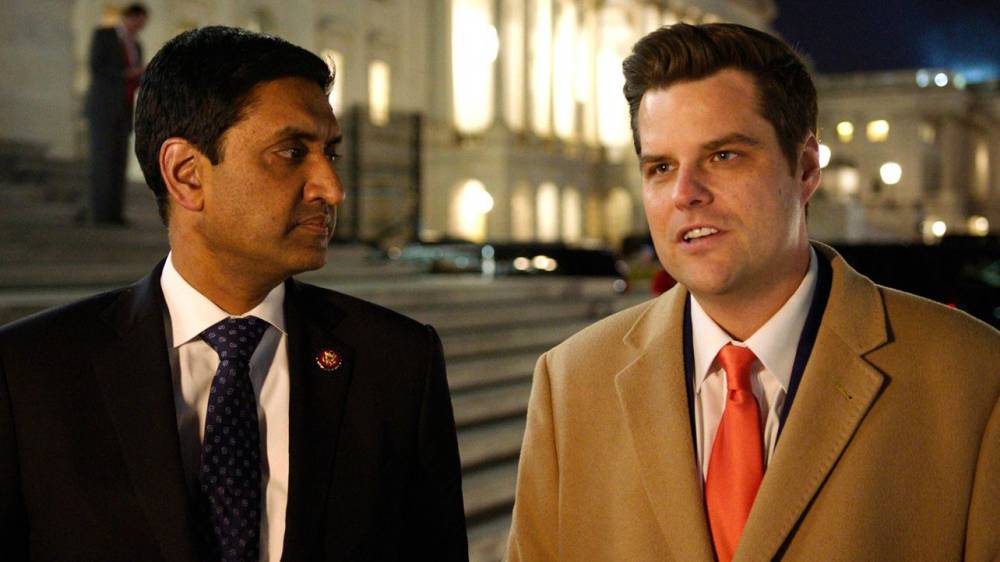
In the most strange, most uplifting of the documentaries viewed during this period, The Swamp finds hope in the most surprising of places: the bizarre friendship forged between the far-right Congressional Freedom Caucus and the far-left Congressional Progressive Caucus. The film features a series of interviews and fly-on-the-wall moments as a group of representatives try to weed out the special interest lobbyists that have corrupted Congress over the past fifty years. At the center of it all is controversial Congressman Matt Gaetz, the Trump-supporting Congressional attack dog, and his friendships with Katie Hill and Ro Khanna as they try to abolish the greed-centric manipulations of Kevin McCarthy, Mitch McConnell, and Nancy Pelosi, as well as the War Powers Act of 2001, in what Gaetz and his colleagues refer to as “draining the swamp.”
If there’s one takeaway you’ll have from The Swamp, it’s the fascinating look into the mind of Matt Gaetz. It’s easy to write Gaetz off as a douchebag figure of the modern era of politics. He’s risen to power through name-calling and a list of controversial actions including posting threatening tweets about Congressional witnesses the day before they testify, inviting Holocaust-denying alt-right leader as a guest to the State of the Union, and his infamous moment wearing a gas mask on the Congress floor to mock Covid fears (shortly before his own staff tested positive). And directors Daniel DiMauro and Morgan Pehme certainly don’t soft-pedal these viewpoints. But one thing that’s clear from the jump is that Gaetz the human (as opposed to Gaetz the politician) is…weirdly charismatic. Unlike the colleagues he considers allies, not friends, like the infamous Jim Jordan, or even his brothers-in-arms featured in the movie, like the super green, yet slightly prickish Thomas Massie (who has his own redemptive arc we’ll talk about soon), Gaetz is shown in his humanistic glory. He’s admittedly a funny, smart, and admittedly stylish individual with a strong moral center. As infuriating as it is to see him making smarmy, punchable statements on TMZ or pandering to little old ladies whose number one voting issue is kids not knowing the National Anthem (and then proceeding to not know the National Anthem), it is weirdly invigorating to see him fight for things that are right. I enjoyed his efforts to reach out to the other side (even though he mostly just seeks out “liberals” who already kind of agree with him). And few moments were as uplifting all year than his spirited defenses of his Democratic colleague Katie Rich, who was run out of Congress by both parties over sexual exploitation by her lover/assistant, and whom Gaetz rightly points out was a victim of revenge porn. As weird as it is, the film paints Gaetz as a fascinating, charismatic protagonist, if not a hero.
Furthermore, they dive into the psychosis of Gaetz’s controversies and find a fascinating – if not entirely forgivable – logic behind them. Without taking lobbyist money, Gaetz can’t fundraise the same way his colleagues can. In order to get reelected, he needs to keep his name in the minds of voters. In order to get on TV, he needs to do outlandish things – things that will make MSNBC rant about him for weeks while Sean Hannity has him on for a series of borderline-fellating interviews. His controversies are less about personal belief and more a strategy to stay in Congress and keep battling the dark money ruining this country. At the end of the day, Gaetz’s greatest sin is less his unseemly friends or actions, and more just his general obliviousness to certain character flaws. After all, despite his belief that he’s a Washington outsider, he remains obtuse to his explanation that he’s a fourth-generation politician (although he does admit to his advantages near the end). And as adamant as he is about draining the swamp and the negativity of political favors, he seems more delighted than outraged that his friendship with the President gives him opportunities others do not get – he joyfully shows off a picture from a White House bill signing in which he “had no reason being there, as he did not write the bill, and actually didn’t even vote for it.” Still, if “draining the swamp” is his motivation to fight against universal evils, then far be it from me to tell someone their math is wrong if they get the right answer.
However, while Gaetz is the most interesting character in the drama, he is not the focal point. The more exciting central conceit, especially in these divisive times, is the alliance of the Freedom Caucus and the Progressive Caucus in their attempt to strip power away from Big Government (or “The Swamp,” or “The Establishment,” or “The Koch Brothers” or whoever you want to call it) and return it to the people. Specifically, the film focuses on two battles that occurred in the year 2019: amending the War Powers Act and HR1 and its efforts to do away with lobbyist money in Congress. An important component of the film – and the protagonists’ world viewpoints – is understanding exactly why things are so broken. To that point, the general consensus (as culpable as they all are) is a combination of partisan news and rules implemented by Newt Gingrich that shifted power away from the people and into the hands of perpetual campaigners that openly appeal to the coal, gun, and environmental lobbies. It’s a system that flourished under Gingrich (surprisingly, both Republican and Democratic talking heads blame him for these efforts, and kinda regard him as a general douchebag), but has been perpetuated in Congress by Nancy Pelosi and in the Senate by Mitch McConnell (whom both sides presented in this movie hate even more). Gaetz and Massie carefully break down ways the system works against them – for example, if you want to have the power to create change as the head of a committee, you need to pay a fee, and to pay a fee, you need money, and to get money, you need to become a whore to the lobbyists. And with the House up for reelection every two years, they become more susceptible to lobbying and manipulation. The film also breaks down how partisanship has become the tool of the lobbyists in order to prevent change – as news channels became more partisan starting in 2002, a generation “became convinced the other side was the devil.” Lobbyists preyed on these fears to withdraw funding from anyone who challenged their “status quo,” and requiring even our protagonists to head onto Fox and CNN to bash rival Congressmen already established as their behind-the-scenes best friends. The Swamp shows us all this to help elaborate on what our protagonists are up against.
This massively broken system is such an exciting foil that it makes the strange, wonderful alliances formed by the two Caucasus so much more inspiring and – dare I say – heroic. The heart of this film comes not in the disagreements, but when they agree over concepts that shouldn’t be that controversial. Arguably the most humorous friendship in the film is that of Matt Gaetz and Ro Khanna, two staunch opponents who come together often to fight for term limits, nonpartisan redistricting, a lifetime ban on lobbying from former members of Congress, a ban on lobbyist money in Congress, and limits on the Executive Branch’s unchecked ability to abuse the War Powers Act (something both Obama and Trump campaigned against before immediately falling into the pocket of the military-industrial complex). Similarly, Thomas Massie (who is controversial in his own party for voting against party lines 25% of the time) works with lifetime liberal Barbara Lee to repeal the War Powers Act – the 2001 bill that awarded unparalleled power to the President against Constitutional norms. Lee was famously the only person in all of Congress (and the Senate, for that matter) to vote against the bill, a move Massie applauds her for as the ultimate sign of moral backbone and unmitigated hindsight. These two platforms lay the groundwork for actual change and bipartisan compromise, and it doesn’t stop there. Some of the greatest sighs of relief come as we watch the people we see on the news supposedly driving division oftentimes expressing bipartisan and general senses of logic. Republican Ken Buck lays out a fairly levelheaded commentary on the Mueller testimony regarding it serving as a loss for both sides, with interpretation falling to how brainwashed you are by your news outlet of choice. Gaetz, whose personal journey involves making the tough call to officially refuse all lobbyist money, openly praises his staunch enemies Bernie Sanders and Alexandria Ocasio-Cortez for having the strength to withstand corporate influence. And both the Republicans and Democrats agree over the flawed nature of HR1, and casually debate whether its broken state is worth passing with their reasonable concerns. After four years (and beyond) of horrific partisanship where both sides seemed so interested in destroying the other that the average Americans fell by the wayside, it’s nice to see our elected officials growing a f*cking spine and taking a stand.
As for the actual filmmaking on display in The Swamp, directors Daniel DiMauro and Morgan Pehme walk a thin line between quality and their own usual shortcomings as documentarians. One of my biggest grievances with their style of filmmaking (it’s unbearable in their equally-solid Get Me Roger Stone) is the insistence on using famous movie clips to drive home certain quotes by the characters (especially the geeky Massie, who inspires Star Wars and Lord of the Rings references). It adds nothing to the overall story, and is quite simply the laziest trick in the documentary playbook. But for the most part, the duo keeps things on track. There are several moments that capture their ability to use their cinematic background to craft a story, like a terrific Christmas-centric moment where Gaetz shmoozes voters intercut with protests growing for impeachment during December 2019, all set to Nat King Cole’s “Deck The Halls.” In a terrific embodiment of friendship in the face of partisanship, there’s an incredible moment near the end where Gaetz and Kanna walk down the street together while two sets of protesters – one liberal and one conservative – flank the duo and immediately begin fighting with one another, all while the friends march on silently. It’s a poignant moment, both in capturing their friendship and as a sign of what they’re up against. And in terms of the filmmakers’ “partisanship,” I would argue they actually utilize it as a successful filmmaking tool. Every once in a while, they break the filmmakers’ “fourth wall” to challenge Gaetz and Massie on their more controversial viewpoints, and often counter with real-life footage that seems to refute their take. But unlike other documentaries, it is never used here as a “gotcha” moment, or as a critical rebuke of their opinion. It is simply to show where the divide comes from, and establish a difference of opinion. It disagrees without resorting to insulting. And that’s what helps elevate it as a film overall.
The Swamp is a rare political documentary that provides hope in the face of unrelenting bleakness. It proves that bipartisanship is still possible, and change can occur in the face of overwhelming, unrelenting odds. I remain in awe of the filmmakers’ ability to create a dramatic arc for its characters – especially with such partisan figures – which is always an impressive feat in a documentary. It’s not an easy watch – these are still incredibly flawed politicians, and even on their best days, their odds are almost impossible. But in the face of…all this…isn’t it nice to hope? It seems we’re in a different America now, one that will have to focus on bipartisanship in order to function. Hopefully the next government takes after the lessons of this film. We could all use a little support from the people we elect.
B
The Swamp is available on HBO and HBO Max
The first and second parts of this series will be posted throughout the day today, and can be read here and here


Add Comment