
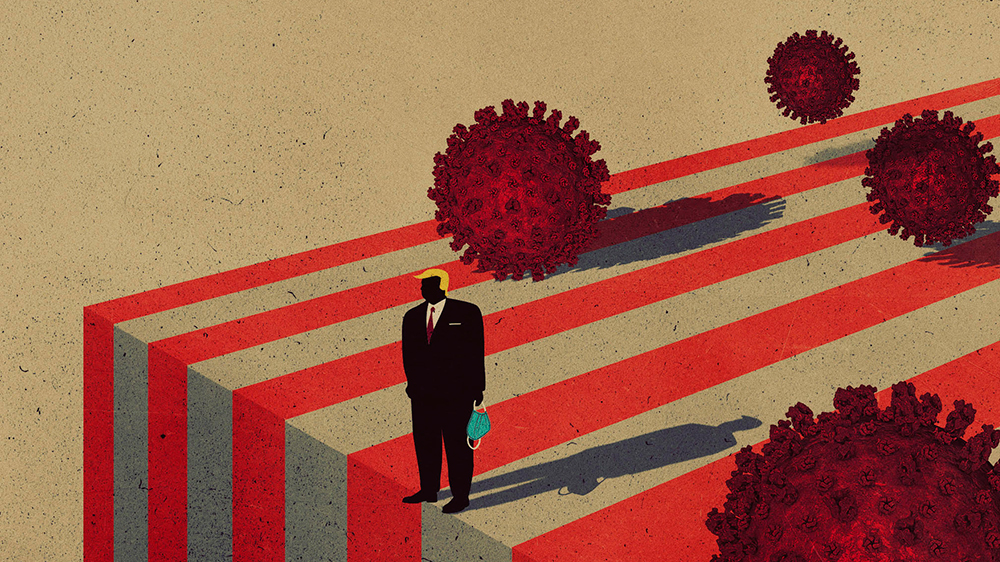
The following is a three-part series of reviews on documentaries pertaining to the 2020 Election and the current state of politics
Today, one of the most fraught elections in recent memory will come to a head, as millions of Americans gather to cast their vote for the next President (almost 100 million have already cast ballots through absentee ballots and early voting polling places). As we watch two less-than-ideal candidates go head to head after four years of tense division, bloodshed, and a global pandemic that has ravaged our country, it’s easy to think to ourselves a series of questions: How did we get here? What is going on? And is there any hope for our broken government to fully recover? Well, three documentaries this year, whether knowingly or otherwise, tackled these questions in rather unique, massively important ways. Boys State explored how the system became broken to begin with. Totally Under Control pulls back the curtain to explore exactly how f*cked up our system is. And in the strangest of all, The Swamp explores a strangely uplifting bipartisan effort inside Washington seeking to fix some of these damages. And as the election weighs upon us, I took a look at these films to see what they had to say, how they said it, and whether they were worthwhile.
In Totally Under Control, legendary documentarian Alex Gibney seeks to demonstrate how widespread government failures, both intentional and otherwise, led to the current global pandemic ravaging our country, decimated our economy, and left 200,000 people dead. Starting with the first case in China, the film chronologically follows the sequence of events as the disease spreads through China, infects travelers in bordering countries and the United States, and ultimately allowed the U.S. to become the highest source of deaths in the entire world as government officials sat on their thumbs and lived in denial. The film also juxtaposes these widespread failures with South Korea, who utilized prior U.S. strategies and sciences to get a handle on the pandemic before an economic shutdown was even necessary.
Totally Under Control is a film about failure, and helping us understand it. And the Covid-19 pandemic is a clustf*ck of failure across the board. Gibney does an excellent job breaking down who failed where, and despite what the overall narrative may appear to be, that blame doesn’t solely land at one person’s feet (but we will talk about them in a minute). The film walks us through the failures of the Chinese government, who were so confident they could contain the virus they didn’t tell other countries for an entire month, and only after satellite images made it clear they were building new hospitals at a rapid rate. It falls at the feet of citizens so unwilling to take threats to their health seriously that the U.S. strain of the virus literally got passed around during a square dance. But most of all, the blame falls at the feet of the CDC. Even removing the CDC’s bosses for a second (and don’t worry, we’ll get to them), the interviews and information laid out by Gibney paint a picture of widespread failure. Warning signs were ignored (sometimes in hilariously obvious ways). Asymptomatic spreading wasn’t taken seriously until five days after it was too late. And in the greatest moment of failure, the CDC sent out faulty tests that could have been easily fixed, and for reasons the film doesn’t fully establish, took three weeks to fix, ultimately slowing any chance we had at monitoring and containing the massive rates. To be frank, I kind of get how these failures happened – even if you remove the libertarian bureaucrats (an oxymoron of terrifying proportions) from the equation, even the “heroes” in the CDC were the types of bloviating egotists who proudly nicknamed themselves “Operation: Red Dawn” in their email chain because of the asinine 80s film of the same name. There isn’t a single person involved in the handling of the coronavirus pandemic – not even the interview subjects seen here – who escapes without blame for the nightmarish results.
But let’s make no mistake: while the film does break down the early failures of doctors and organizations across the board, the key focal point here is the complete failure, intentionally or otherwise, of the current Administration in the White House. What’s fascinating about the film is that it really does try to give the President every chance to redeem himself and follow his logic whenever possible. The film admits that he’s not alone in bungling pandemics (Obama mishandled vaccines during H1N1 and moved too slow on Ebola). It concedes that pandemics are never the first priority of a leader due to their rarity. And it commends the international shutdown (even though it points out that both plans lacked logistics for what would happen once Americans came home). But even if you admit he was thrown into the deep end, he wouldn’t have been so unprepared if it weren’t for a blatant mistrust of everyone around him. After all, if you consider all scientists the Deep State and believe that any strategy connected to a previous administration (no matter how helpful) a complete failure, your logical conclusion is just to discount all fact and logic and start from scratch. That line of thinking is why the entire team in charge of handling the pandemic were controversial novices taking over for predecessors who resigned in disgrace, including Secretary Azar, Dr. Redfield (who has been investigated for fraud twice), and Bob Kaldec. Totally Under Control makes it clear that this was a President preoccupied with reelection and battling impeachment, who didn’t want to trust those around him unless they swore undying loyalty, and was so convinced that he was right he continued to flaunt findings and human decency as a way of proving a point.
The film takes us through, case by case, the ways that the President’s handling was mismanaged, in ways that the media (more often focused on presenting the “What” as opposed to the “How”) often sidelines in the race for great headlines. And ultimately, the film argues, the failures came in two waves. The first wave tackled the effects of ignoring science and insistence on being right the first time, and the result this had on the early tackling of the pandemic. And as can be expected, the answers are so simple, they appear to be right under our noses. There was no playbook to follow because, in an effort to “clear the stain of the last administration,” the President’s team completely threw away President Obama’s playbook. There was no team to offer insight because former Secretary John Bolton (now a Never Trumper and completely moraless shill) fired the Global Health team. The only person involved with the pandemic with any medical background was Dr. Fauci – whose juxtaposition with the rest of the new “team” helped elevate him to modern folk hero status. And when the folks who remained at the CDC asked back in January for additional funding to develop a vaccine, they were reprimanded for their audacity. Much of this information came out so late because figures as varied as Secretary Azar and Senator Mitch McConnell did everything in their power to get ahead of the narrative while they still could.
That’s why it’s so important that Gibney places emphasis on the emails he’s been made privy to. Were he simply to explain the series of events as he interpreted them, it would leave the film vulnerable to claims of partisan hatchet work. By incorporating evidence into the story, it not only helps the viewer understand more clearly, it also undermines any claim the Administration has made, whether it’s denying the film’s authenticity or claiming that CDC administrators signed off on anything – from limited testing to mask efficacy to hydroxychloroquine – with anything less than a gun to their head (metaphorically speaking…I hope). Because of the obsession with perception, the science was universally ignored to sell a more “uplifting” image – testing was delayed to “keep numbers down” (perhaps where the President’s newest talking point comes from), emails advising we follow the 1918 model went unread, and bureaucratic red tape went overlooked. Doctors and advisors were repeatedly replaced with public figures more capable of sticking to the pre-approved script. And ultimately, new officials at the CDC were appointed to censor and rewrite official briefs to better align with the “core message.” The film traces the effects of placing ill-prepared people in charge of massive organizations with the sole purpose of “just keeping the information on-brand.” And it still pales to what comes next.
The second wave, meanwhile, focuses on the role that greed and power had on the President, as he and his son continuously manipulated the system in order to strongarm the states. It’s a bitter pill to swallow, and one that might receive some pushback from some dyed in the wool followers. But Gibney uses combinations of email evidence and on-the-record interviews to lay out a case as carefully as possible. He walks us through the days in February where Trump, caught up in early estimates of low, containable numbers, refused to run tests out of hope that numbers would appear misleadingly low. The lack of preparedness led to an overwhelming of ICUs and a limited availability for ventilators and PPE. And that’s when the interviews with folks like Scott Becker and Max Kennedy become vital – because they lay out a damning case of neglect when it comes to the PPE debacle, which is laid out clearly and succinctly. I don’t want to give it all away, because each twist over the fifteen minute period becomes more and more jaw-dropping. But to lay out the kind of bombshells this film comes away with, we basically witness the incompetence of someone selling off the entire U.S. stockpile of prepared PPE, buying them back late and haphazardly for 10x the cost, and trying to earn the money back by forcing an “eBay style” auction between the individual states – an auction where the Administration constantly jumped in to bid themselves, just to drive up the price. And I haven’t even gotten into the fact that the task force in charge of handling all this with Jared Kushner was a group of unpaid college interns, or the fact that Democratic governors were told (on tape!) that if they wanted the PPE, they’d have to hold a press conference praising President Trump. All of this occurred while 200,000 people – 20% of the international death number, and disproportionately Black and Hispanic citizens – tragically and needlessly lost their lives. This film captures the psyche of a man in crisis, panicking that a crippling economy would cost him a reelection bid, completely unaware that handling the problem up front would have saved the economy. It’s the tell-tale sign of a good documentary: the ability to capture real-life moments of Shakespearean tragedy.
Perhaps the smartest decision the film makes is comparing the South Korean response to Covid-19 with that of the United States. Gibney brilliantly cuts back and forth between the two countries, and with good reason. Both nations detected a Patient Zero on the same day, and had the same amount of time and opportunity to act, and yet took rapidly different approaches. What’s darkly humorous about Totally Under Control is the narrator’s constant reminders that everything South Korea did came from the aforementioned playbook and scientific breakthroughs the United States had used in previous outbreaks. By jumping on top of testing the minute Patient Zero was identified, and leaping into action before the death toll reached four, South Korea had tracked the virus to a karaoke club and a church, quarantined them immediately, and instituted a mask policy nationwide. Through their efforts and an overall emphasis on science, the pandemic was controlled before the death rate exceeded 500 and without an economic shutdown – all while the United States prided itself on “Zero deaths, thus no action is needed” and an incitement of protest and violence against a nationwide mask policy. It’s both uplifting and infuriating to see South Korea find such success while we continue to suffer, but it at least comes with an intriguing explanation: the reason South Korea was so prepared this time around was because they had already gone through an epidemic of their own five years ago, which was bungled by a controversial President who placed more emphasis on economic growth than human life and ultimately was removed from office. Just an observation.
Unfortunately, the film’s weakest aspects come in its filmmaking. There is a lot of innovative stuff on display here. I really appreciate the simplicity of the straightforward timeline approach that makes it clear how things went wrong in an easy-to-follow way. There’s a lot of really interesting focus on how the film was prepared during quarantine, involving DIY cameras and a specially handled camcorder that subjects could pick off their porch and conduct Zoom interviews with Gibney and company. And there’s a legitimately cool rewind effect used when the film backs up to drop its (already-revealed) “smoking gun” with the Bob Woodward tape. But overall, the film has more than its fair share of cheesy gimmicks and lame demagoguery. After all, this film from the jump utilizes the most masturbatory of visual cues and over-the-top direction. There are more overhead shots of empty highways and ghostly effects set to spooky music than the average episode of The Walking Dead. And you just know from the jump that this film is going to resort to some lame #Resistance jokes, including both a “You’re Fired” reference and the über-Twittery “In a maybe brilliant piece of irony, he picked ‘Live and Let Die’ to score his maskless tour of a PPE factory. Listen, your evidence is already damning enough – don’t ruin it by making me hate siding with you. Even the content can occasionally seem a little lacking – while it makes its case impeccably, there are a few moments that feel as though the filmmakers chose not to explore every possible angle to its natural conclusion in an effort to make an overall point. And while I appreciate the use of emails and other such evidentiary materials, it’s worth noting that this film is missing a true “smoking gun.” All of this information is well and good, but the reason Michael Moore’s early films like Roger and Me and Bowling for Columbine or Joshua Oppenheimer’s The Act of Killing work is they manage to drop a massive bombshell that no one sees coming – not the interviewers, and not the audience. While this film does provide some new insights into our early failings and Jared Kushner’s skullf*ckery, it doesn’t really give us any new information. It’s an excellent, informative PowerPoint, but it’s nothing more than that.
Totally Under Control is a scathing indictment of a system asleep at the wheel. It traces how bad decisions at every level can undermine a recovery and decimate the lives, literally and figuratively, of 350 million people. The film makes clear an ironic picture of an alternative society, where hundreds of thousands of lives are saved and the economy remains bolstered if the person at the top had made the right choices – acted in February, moved quickly on the bungled tests, and caught the disease quick enough for contact spreading. Instead, we got a campaign of misinformation and “This Is Fine” fire dogs as Rome burned. This series is about documentaries that follow our current political process to their harrowing conclusion, and ultimately, despite the many flaws in Totally Under Control, its depiction of widespread political failing remains poignant in spite of it all. Take care, be safe, and please remember to vote!
B-
Totally Under Control is available on Hulu and can be rented on most streaming platforms. Neon has also made the documentary available for free on their website for the foreseeable future
The first and third parts of this series will be posted throughout the day today, and can be read here and here


Add Comment